Why Runners Cry at Finish Lines
Months of training deplete the brain's ability to contain overwhelming emotion.
Runners cry at finish lines because the body has no filter left to stop them. A 16-week training block reshapes daily life entirely, subordinating sleep schedules, nutrition, social commitments, and family time to the build.
What the body does at the finish line
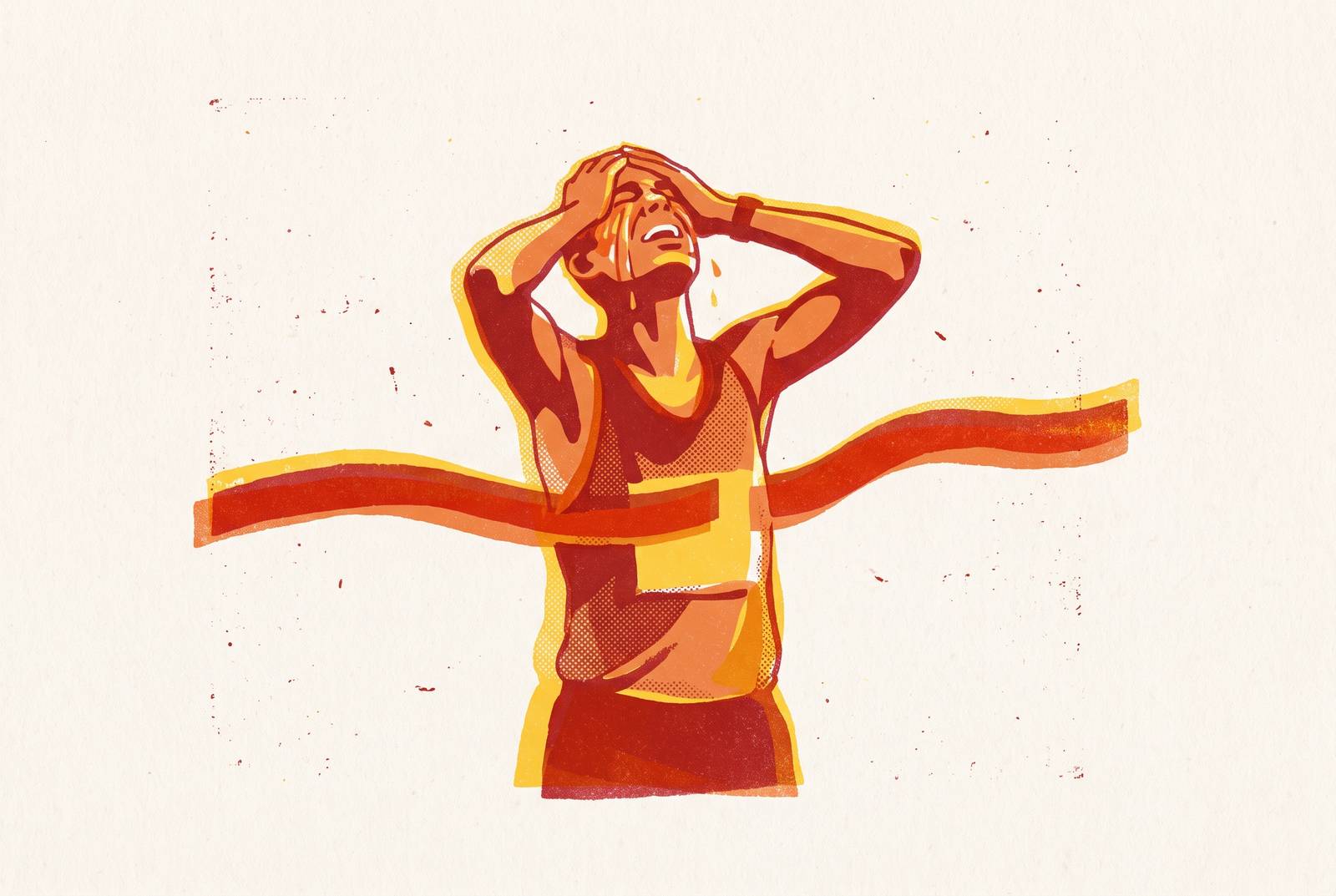
A runner crosses, stops the watch, breathes in, and comes apart within seconds, a pattern that repeats across marathon footage. The tears are the visible output of a brain that has run out of the resources it needs to keep emotion contained. This isn't dysfunction: crying at the finish line isn't a sign that something's wrong, but rather the body's attempt to regulate an emotion so overwhelmingly positive that ordinary responses like smiling or laughing aren't powerful enough for what the runner is feeling.
The prefrontal cortex handles that containment under ordinary circumstances, managing rational thought and emotional regulation the way a dam manages a river. Hours of sustained physical effort drain it, and by the later miles of a marathon, the mechanism that would normally hold joy, relief, disbelief, or grief in check has stopped functioning well enough to do the job. Whatever the runner feels at that point comes out raw, because there's no longer the neurological capacity to edit it.
That collapse doesn't happen in isolation. Cortisol levels measured half an hour after a marathon have rivaled those recorded during military interrogation or skydiving, Canadian Running Magazine has reported, a measure of how much physiological siege the body has endured. Layered under that stress response, a churn of serotonin, oxytocin, dopamine, and GABA has been shifting throughout the race, and all of it resolves abruptly the moment the runner stops moving. The flood follows that resolution almost immediately, because the chemical scaffolding that had been propping up sustained effort simply isn't needed anymore and drops away.
A second trigger is easy to mistake for the emotional one: Ultra-marathoner and Quora contributor Jeffrey Smith has described depleted fuel reserves producing their own kind of emotional instability mid-race, distinct from anything psychological. Smith treats unexpected emotion during a run as a signal to eat, not a signal that something has gone wrong. The finish-line cry and a bonk-induced wave of feeling can look similar from the outside, but one is metabolic and one is the terminal event of months of buildup.
How months of training amplify the release
The chemistry explains why tears happen. It doesn't explain why they can knock a grown adult sideways in front of a few thousand strangers, and that scale comes from what got poured into the training block long before race morning.
Sports psychologist Dr. Angie Fifer has pointed out that a 16-week training build reorganizes daily life around itself, with sleep schedules shifting, nutrition managed with new discipline, and social plans and family time bending around long runs and recovery days, so none of that sacrifice is incidental. Each sacrificed morning or skipped dinner out becomes part of what the body is settling accounts for at the finish line.
Writer and podcaster Emily Abbate captured this after running her fastest marathon, saying that crossing the line "is so much more than just a single day of sustained effort." She traced her own arc back to 2007, when she couldn't run a single mile without wanting to stop. That distance, from a runner who once quit at the quarter-mile mark to one setting personal records over 26.2 miles, is the real material the finish line is releasing. The race itself is just the last data point in a much longer story.
Somewhere in that story, running turns from a fitness pursuit into part of how a person understands themselves. The marathoner who finishes doesn't just complete a course, she resolves months of having organized her identity around getting there. Marathon runners commonly move through phases of excitement, doubt, boredom, and anger over a training cycle, arriving at a final emotional release at the finish. That sequence didn't start on race morning. It started the week the training plan did, and the finish-line cry is simply where it terminates.
How the finish line charges the crowd
None of this stays contained to the runner. Spectators lining the final stretch of a marathon often end up crying too, and the mechanism behind that deserves to be taken seriously rather than dismissed as secondhand sentimentality.
Manhattan clinical and sports psychologist Dr. William Wiener has compared the experience of watching a marathon like New York's to watching a film that pulls an audience into feeling something collectively: the setting itself creates a connection that produces an emotional response. Spectators start feeling what the runners are feeling as they cross, even when those runners are complete strangers they will never see again.
Sociologists call this collective effervescence, a concept a 2026 Everyday Sociology piece confirmed while examining marathon culture specifically. Throughout the race the brain has been flooding the system with endorphins, activating positive feeling and suppressing pain and stress, the same system that produces the runner's high, and this physical and chemical storm resolves the instant the runner stops. Runners taper and carb-load and lay out gear the night before; spectators plan routes to catch friends at multiple points, make signs, and show up hours early to claim a spot near the finish. Both groups are, in effect, rehearsing the same emotional buildup from opposite sides of the barricade, so that by the time the leaders and then the mass of finishers come through, the crowd is already primed to release something alongside them.
Dr. Fifer has added a further wrinkle: spectators watching a marathon are sometimes confronting their own unrealized ambitions, and the tears they shed for a stranger crossing a finish line can carry weight that has little to do with that stranger at all. Pia Tempongko's third marathon shows the reverse current, where the crowd acts on the runner rather than the other way around. Knee pain from mile 11 had already brought her to tears mid-race out of pure disappointment. By mile 21, seeing the dense, cheering crowd stacked up ahead of the finish, she "ugly cried," in her own words, undone by the crowd's energy in a way that miles of physical pain hadn't managed.
Crying doesn't require suffering, and not crying doesn't mean feeling less
Every finisher goes through some version of this reckoning. Not every finisher cries, and that distinction matters enough to state carefully.
Dr. Fifer draws the line without hedging: "Runners who don't cry are no less invested, overwhelmed, or excited. They just didn't have that particular emotional response". Some athletes are trained specifically to hold emotion in reserve rather than release it at the tape. Nike Run Club coach and ultra-marathoner Jes Woods tells the runners she coaches to "bottle up all that energy and emotion and use it as fuel until the finish", treating the same emotional charge as propulsion rather than release. That's a legitimate strategy, not a suppression of something that should have come out earlier.
A milestone is personal, regardless of pace or distance. A runner finishing a personal milestone stands at the same kind of finish line as a runner chasing a sub-3-hour marathon, even though the clock reads wildly different numbers for each of them. There's a fair objection to raise here, that tears at a finish line are at least partly performed, shaped by the cameras and the crowd and the cultural script that says this is a moment for crying. That's a reasonable point, but it doesn't undo the underlying event. The prefrontal collapse and the hormonal resolution happen on schedule, tears or no tears on camera. What varies is the expression. The mechanism doesn't.
What comes after the finish line
The emotional arc doesn't end when the medal goes around a runner's neck. Euphoria at the finish line commonly gives way, within days, to something closer to emptiness, a documented pattern among endurance athletes described in a 2024 study cited by Canadian Running Magazine. The high doesn't just fade, it inverts, and runners who trained hardest are often the ones who feel that inversion most sharply.
How steep that drop feels seems to depend heavily on how much a runner had invested and whether they've already lined up something new to aim for. That euphoria-then-emptiness framing is documented in a BMC Sports Science study on post-race emotions in endurance athletes. The more completely someone had rebuilt their daily life and self-concept around the training, the more disorienting it is when that structure suddenly has nowhere left to go. Runners Blueprint maps the days immediately following a race in blunt terms: high, emptiness, sadness, now what. The prescribed response is recovery, a proper race recap, and deliberately not rushing into the next training cycle just to have something to fill the space.
That last part carries a real cost when skipped. Runners who jump straight into a new build without processing what they just finished often lose the chance to consolidate the experience, the part of the process that turns a hard effort into something that feels meaningful in hindsight rather than just completed. A finish-line cry, whatever form it takes, is part of that consolidation. It's the moment where the body and the achievement finally get reconciled with each other.
Race organizers appear to understand this dynamic better than they get credit for. The 2026 Boston Marathon introduced a redesigned finisher medal for its 130th official edition on April 20, 2026, gold on a blue and gold ribbon, manufactured by North Attleborough-based Ashworth Awards. The B.A.A.'s own announcement and Marathon Handbook corroborate that description of the medal. A medal redesign is a small thing on its own, but it signals that the people running these events know the object a runner carries home matters nearly as much as the moment of crossing. It gives the emotion something physical to attach to once the adrenaline is gone.
How runners make the finish-line moment last
That need for a physical anchor hasn't stopped at medals. An entire category of commemorative objects has grown up around the specific logic that a generic souvenir can't hold the weight of what a runner just went through, and that only something built from the runner's own race data carries enough specificity to do it.
Users upload a GPX file from Strava, Garmin, or AllTrails, or connect a Strava account directly, and the company also offers pre-designed sculptures for more than 500 iconic races, including the Boston Marathon, Leadville 100, Hardrock 100, and Western States. Mark Your Moment works from the same principle through official partnerships with the TCS Sydney Marathon 2026, Edinburgh Marathon Festival 2026, and ASICS Gold Coast Marathon 2026, turning a runner's GPX upload into a personalized route print sold as an official race memento. The ASICS Gold Coast Marathon's own site confirms the "Mark Your Moment × Official 2026 ASICS Gold Coast Marathon" partnership.
A parallel craft tradition has grown up around embroidery, particularly on platforms like Etsy, where custom marathon gifts are built on a proof-before-production process: the seller sends multiple proofs before anything ships, a back-and-forth that mirrors the intimacy of the finish-line moment itself rather than just packaging it. Made-to-order running shorts embroidered directly from a runner's GPS race data push that logic further still. The course stitched onto the garment is the exact route that runner finished, not a stock design, and the shorts don't get made until the runner has approved a proof.
Even the gear worn on race day has started drifting toward this same category. Solereview notes that shoe companies have stretched their release cycles considerably, with models like the Adidas EVO SL and New Balance Rebel staying current for longer stretches. A shoe that isn't swapped out every season starts accumulating its own history with a runner, making the pair worn on race day feel less disposable and more like part of what gets kept afterward.
None of this exists because runners want more stuff. It exists because a finish-line cry that took months to earn deserves something on the other side that was actually built from the race itself, not something pulled off a shelf beforehand. The tears prove how much the effort cost. What a runner carries home should reflect that cost honestly, made from the thing itself rather than manufactured in anticipation of it.
Sources
- Why Do People Cry At The Finish Line Of A Marathon? - The Running Channel
- Why do marathons make us cry? - Canadian Running Magazine
- Why do marathon runners cry after they win? - Quora
- The Mental and Emotional Journey: Marathons Are as Much Heart as Muscle —
- Why Do Marathons Make Me Cry? - Elemental - Medium
- Emotional Release: Why Runners Cry at the Finish | RunnerClick
- Why We Cry (and Laugh, and Scream) at Triathlon Finish Lines
- The Collective Effervescence of a Marathon – Everyday Sociology