Running the Same Race Every Year as Tradition
Runners return to the same race year after year to mark personal growth and deepen community bonds.
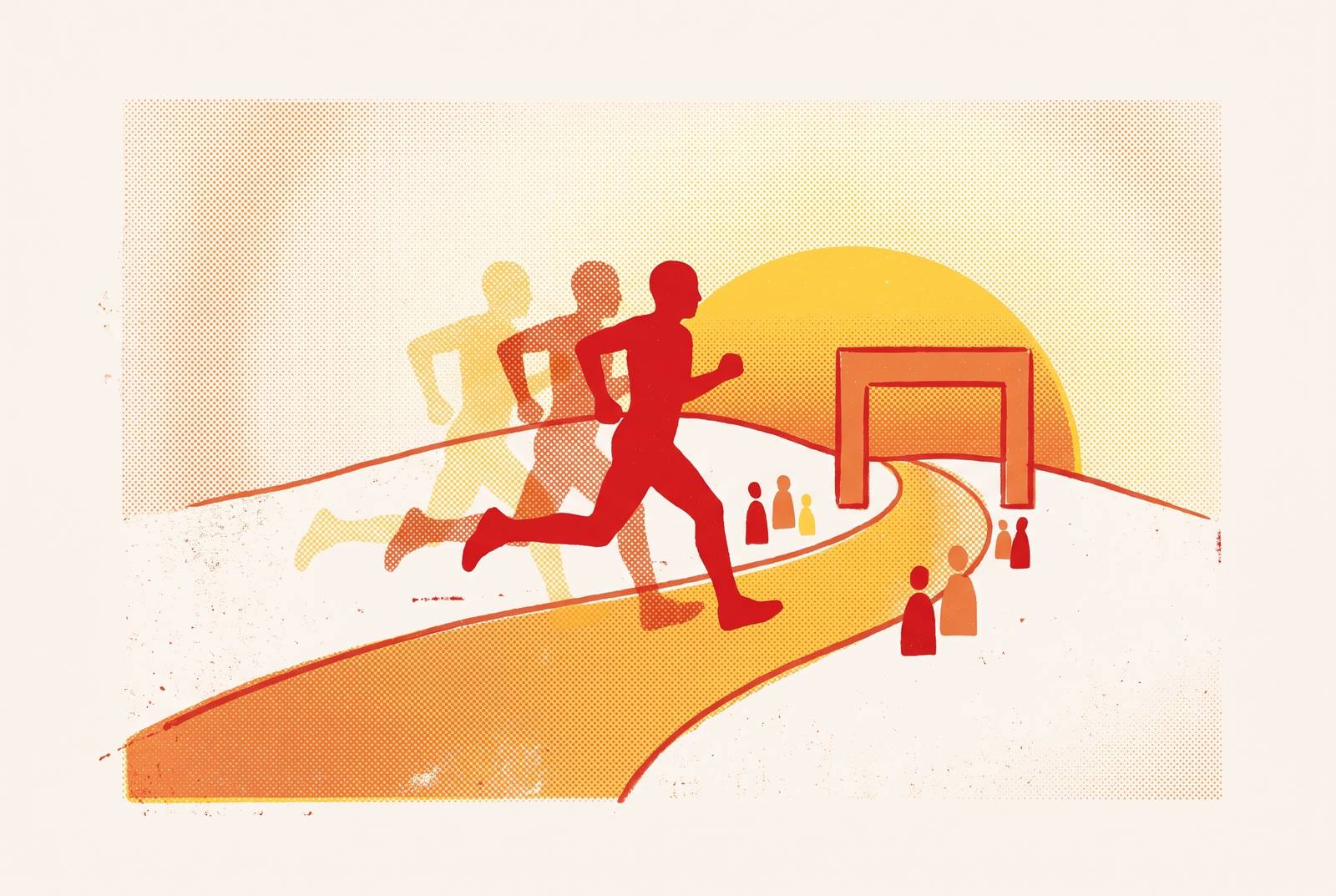
Running the same race every year is less about repeating a course than building a tradition. Each return joins a new season of training, a changed life and a familiar community to the same finish line. Over time, the race becomes a personal ritual whose meaning depends not on novelty, but on the history the runner brings back to it.
Why runners go back to the same race year after year
A runner crosses the finish line worn out, then starts to picture standing on the same start line next year. The distance has not become any less demanding. Yet the wish to return can emerge before the effort has fully receded. The familiar runner who swears off marathons at mile 24 and signs up again within weeks expresses this tension precisely. The pain fades, while what it means to have finished stays with the runner.
A course the runner knows gives the experience a place, and entering again offers a way to carry it on. The next race will belong to the previous one in a way that an unfamiliar event cannot. It will invite comparison, recognition and recollection, even before the runner reaches the start.
The runner knows where the hard work will happen and remembers what happened there before. The road acquires a personal history. Choosing it again means taking that history into the next effort and giving up the chance of a wholly fresh experience.
How repetition turns a race into a ritual
IMG Academy defines a sports ritual as a behavior an athlete believes has the power to influence performance. Its psychological function is to boost confidence and restore a sense of control. The academy also finds that athletes who feel they have less control over their results rely more on ritual. On race day, much is unknown about the weather, the body and the crowd. Familiar actions give that uncertainty a recognizable frame.
Those actions operate at two distinct scales. The same breakfast, playlist and warm-up organize the hours before the start, while the same race, calendar slot and course organize the larger return. Both provide a structure the runner can inhabit without knowing how the day will unfold. Familiarity gives the runner a known way to approach an unknown result.
But is this ritual, or simply habit? Habit is automatic and unreflective, while ritual is intentional and invested with meaning. The distinction lies not in repeating an action, but in the awareness brought to it. A runner who returns with previous years in mind is doing more than following an established routine. Each edition gives the runner time to look back, feel thankful and connect with others, because the race now holds memories they expect to find there again.
The deep roots of running as ceremony
Daniel Lieberman describes running as a longstanding communal activity, with footraces embedded in ceremonies that cement ties, redistribute crops and goods, and celebrate important events. He places running-centered traditions across the Americas, from the Arctic to the tip of South America. Their variety is substantial, but community is a common thread. Among the Tarahumara of Mexico's Copper Canyons, running includes distances that would constitute ultramarathons and a spiritually vital form of prayer.
The Boston Marathon, run every year since 1897, is part of this long tradition of people coming together to celebrate. In 1936, Johnny Kelley passed Ellison Brown on the last and highest of Newton’s hills and gave him a pat on the back. Brown responded by regaining strength, passing Kelley and going on to win. The exchange gave Heartbreak Hill its name.
That history becomes part of the course runners encounter. A hill is both a physical demand and a place in a story that others already know. Annual return brings another group into contact with that shared past. In this respect, a recurring race does what ceremony has long done, marking time and drawing a community back to familiar ground.
What the training buildup adds to the meaning of going back
For the repeat racer, preparation is the ritual’s longest chapter. A marathon training cycle spans several months, building toward substantial weekly mileage and increasingly long weekend runs. When the race has the same calendar slot each year, those months follow a familiar pattern. The race fixes the destination, and the training calendar fills in backward from it.
The structure repeats, but its content does not. A different body and a different life enter each training cycle, changing what the preparation asks of the runner. The same long run can belong to a very different season of experience. The visible event is only the final portion of that year’s work.
A familiar course also provides a controlled variable for comparison. What the runner knows about pacing, how they plan their fueling and what they decide in race week can change while the roads stay the same, making it easier to see what they have learned. That comparison need not reduce the year to a finishing time. A runner who finishes the same marathon five years in a row brings five different stories of training to the race. Those weeks give the finish its context, and they are part of what deserves to be remembered after the result is recorded.
What runners are working through when they keep coming back
Kevin Masters, a University of Colorado Denver professor who has studied marathon participants for decades, identifies marathon running with “a sense of purpose, responsibility, self-esteem and identity formation”. These qualities can deepen through repetition. The next race gives the runner something else to commit to as they work through another part of their life. Its purpose may be recognizable without being identical to the previous year’s.
For some runners, that work involves grief. For others, it involves who they are or how to stay strong as life changes. The race gives the runner a sustained undertaking, with a start line to prepare for and a finish to pursue. Going back lets the runner carry on with that work, even when their reason changes from year to year.
For younger runners in particular, an annual race can also serve as a life marker when homeownership or marriage feels inaccessible or beside the point. Committing to the race gives the runner a sense of control at a time when life may have few clear milestones. A year becomes distinguishable by what it took to train and return. On the same course, a runner can recognize who they were before, what has changed and what remains unfinished. The comparison is personal before it is competitive.
How the community around an annual race amplifies what repetition builds
The familiar volunteer at mile eighteen belongs to the return as surely as a remembered turn in the road. So do the charity team at the start, the recognizable pace group and the spectators who come back each year. These people give the course a recurring cast. A runner’s own history becomes entangled with the people who help make the event recognizable. Familiarity grows beyond knowing where to run.
Charity participation makes that connection particularly clear. Runners raise large sums through annual races, and a fundraising commitment can make the return feel non-negotiable. The entry then represents more than a personal goal. Other people and a shared cause have a claim on the preparation, giving the runner a reason to continue that does not depend entirely on performance. A private ritual becomes a social commitment.
A post-race meal can become a ritual of its own, while families build their calendars around the event. Children grow up expecting the weekend to return. What began as one person’s race gradually becomes something other people anticipate and remember, with their own place in its story. The runner may cover the course alone, but the annual return is held by a larger circle.
What it means to keep a race, not just run it
Five editions of the same race are connected chapters, with each finish part of a larger story. Yet the objects that remain do not always distinguish those chapters well. Every finisher receives the same medal for an edition, marking participation. It cannot, on its own, express the training build, the year’s context, the finishing time or the reason for returning.
A GPS file offers a more specific record. The runner’s watch or phone captures the course as it was actually run, including the turns, miles and pace fluctuations. The difference resembles that between a handwritten letter and a form. Both have a structure, but only one bears the particular trace of its maker.
Made-to-order commemorative objects can give that trace a physical form through route art, embroidered objects and custom prints. These pieces can be tied to a particular runner, year and finish time. For a repeat racer, the distinction is especially useful. Year one and year five may show the same street map, but the training and the reasons for racing may have been different. The shared shape makes their differences more legible.
Embroidery gives the GPS trace another kind of presence. Slow to make and impossible to replicate exactly, it turns a data file into a craft object that can be worn on a subsequent long run or given to the person who ran the race. Such an object gives the memory a tangible anchor, specific enough to call back one edition.
Why the same race, run again, is never really the same race
The fixed course makes change visible in the runner. Familiar roads provide a point of reference for a body, a life and a purpose that do not stay fixed. Someone lining up for the fifth time brings the previous editions into the present effort. Earlier decisions, difficult stretches and reasons for returning are now part of what the route means. The race holds a personal history that an age-group ranking can only partly tell.
That history also changes how a result is understood. A finishing time belongs to the training that produced it. The ritual keeps a record of who the runner was and what the commitment required, accumulating meaning across editions.
The annual return leaves room for another version of that commitment. At the finish line, this year’s effort is complete, but the relationship with the race remains open. The runner has another chapter to keep and, eventually, another choice to make. Beyond the exhaustion lies the familiar possibility of returning to the start, bringing a changed life back to the same road.