What Runners Do With Their Finisher Medals
Most runners tuck medals away once the race-day high fades.
Most finisher medals end up in a drawer, a shoebox, or the back of a cupboard. The pattern holds across distances and experience levels, from a first short race to a sixth World Marathon Major. The gap between the medal's emotional weight and its physical fate is worth unpacking, because it says something about what the race means and what a single object can hold.
Why the finisher medal lands in a drawer
The medal arrives at the finish line carrying everything that preceded it: the early mornings, the long runs, the setbacks, the accumulated weeks of preparation. None of that is visible on the object itself, which is part of its power and part of its problem. A finisher medal compresses months of work into one piece of metal and ribbon. That compression is exactly what makes the medal both potent and, in the end, inadequate.
For a while, the medal hangs proudly somewhere. It sits on a bedpost or a hook by the door. Then the collection grows, and the first medal migrates. It ends up under a pile of race shirts, or in a shoebox with the others, still meaningful but no longer seen. The pattern is familiar because the medal is doing double duty. It functions as a private reminder of a specific effort and as a public symbol of achievement. That dual role is why the medal matters so much in the moment and why it can feel hollow once the race-day high fades.
What the medal is actually standing in for
A finisher medal is not a decoration in the ordinary sense. It is a proxy for something the object cannot show: the training buildup, the specific route, the decision to keep going when a run went badly. Runners speak about medals as proof, but the proof they are reaching for is internal. A first marathon medal sits in a home office not because it is the most beautiful object the runner owns but because it marks a moment of self-proof. The medal stands in for the runner's own knowledge of what it took.
This is why the medal can feel hollow. The object is the same for every finisher, while the experience behind it is unique to one person. The medal certifies completion. It does not describe the course, the weather, the injury that nearly ended the buildup, or the friend who ran the last six miles alongside. The gap between what the medal represents and what it can communicate is the underlying tension in every decision a runner makes about what to do with it. Display it, donate it, or replace it: each choice is an attempt to close that gap.
How runners display medals when they do show them off
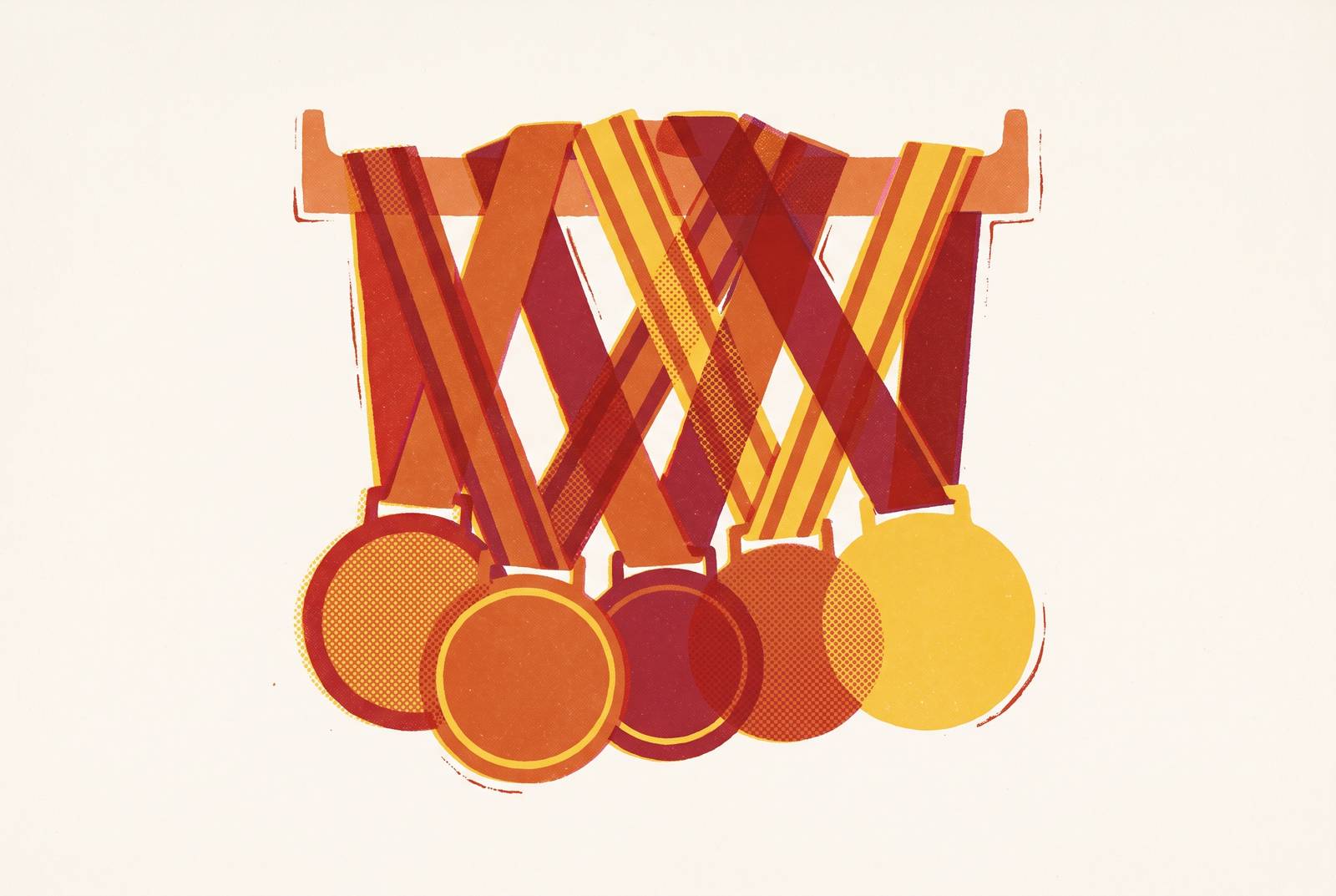
When runners choose to keep their medals visible, the method of display reveals what they value about their racing history. Wall-mounted hanger rails are the most common fix. Every ribbon stays visible, new races are a ten-second addition, and the display grows with the runner. Variations emerge as the collection expands: a single rail for one headline distance, a double rail once a row overflows, or themed rails that separate road from trail or assign one rail per family member.
Shadow boxes serve a different function. Pairing a medal with its race bib and a finish-line photograph turns a decoration into a record. This approach is best reserved for a single landmark race: a first marathon, a comeback after injury, or a six-star finish. The shadow box is not a working display but a memorial to one specific day, and its value lies in the restraint of choosing only one. A fuller approach is the sports memory wall, where medals, bibs, race photos, and personal records sit together and let a runner tell their story across seasons rather than across individual races.
Runners chasing a series often give that series its own dedicated rail, filled left to right. The six Abbott World Marathon Majors is a classic example, as is a decade of the same hometown race. The empty hooks do motivating work: they mark the races still to come and make the incomplete series visible. The display becomes a plan as much as a record.
What runners do with medals they no longer want
The existence of donation programs and opt-out policies reveals that for a meaningful share of runners, the object itself is not the point. The organization accepts only earned marathon, half-marathon, and triathlon medals, not race extras or unclaimed stock. The most telling shift came with London Marathon Events, which from 2025 requires participants to actively opt in if they want a finisher medal. The policy formalizes something the donation programs had already implied: the medal is no longer assumed to be wanted. Race culture is separating the achievement from the object, which raises the question of what runners want instead. The answer turns out to be complicated, because some runners are more attached to the physical medal than ever.
Why medal design has become a race-selection factor
Even as some runners donate or opt out, others choose their races partly on medal design. Race directors have responded by treating the medal as a craft and marketing decision, investing more heavily in design and distinctive artistic elements. The examples are instructive because they show what runners are seeking: an object that looks like the specific race it commemorates.
The Big Sur Marathon has been associated with hand-crafted clay pieces for more than three decades, with the design changing slightly each year but most often featuring the iconic Bixby Bridge. The Illinois Marathon Weekend 2026 medal is designed to resemble a pocket watch, tied to the theme "Leave Your Legacy," with a dial runners can spin to match their finish time. The Little Rock Race Weekend medal is famous for its size, described as roughly the size of a dinner plate. The Boston Marathon medal features the unicorn symbol that has adorned the race since 1887. The Marine Corps Marathon medal honors military service with patriotic imagery drawn from Marine Corps icons.
This design-as-motivation phenomenon reflects the same dual psychology as the medal itself. Runners want an object that earns social recognition and carries personal meaning at the same time. The design is the object trying to carry the story. The more the medal looks like the race, the more of the race it can hold.
Where the medal falls short and what runners reach for instead
The medal tells a runner they finished. It cannot tell them the course they ran, the weeks it took, or what it cost them, and that gap is driving demand for keepsakes built from the runner's own data. A medal is identical for every finisher. The training buildup, the specific route, and the accumulated weeks are unique to one person, and a growing category of objects attempts to preserve exactly that.
GPS route art addresses the gap directly. Converting a runner's own Strava or GPX file into a physical artifact keeps the geography of the effort and turns the route into something frameable, giftable, or hangable. The format has expanded significantly: custom GPX route map posters, framed personalized race prints with name, time, and date, and 3D-printed topographic route plaques are all available. Each attempts to preserve what the medal cannot.
For the most personally meaningful commemoration, the source of the data matters. The right input is the race route itself, the runner's actual GPS track, not a generic course map. That distinction is the whole point. The keepsake carries the specific geography of one person's effort, which is what gives it a weight the medal lacks.
Running as ritual, and what a keepsake is really for
The question of what to do with a finisher medal is really a question about how runners hold onto the meaning of something that took months to build and ended in hours. Running is increasingly understood as self-definition, not just exercise. For many runners, especially those who have been at it for years, the sport is foundational to who they are, and the race is the moment that crystallizes a season of effort rather than a one-time event.
The medal in a drawer is not evidence that the race did not matter. It is evidence that the object could not hold everything the runner needed it to hold. The runners who display their medals, donate them, or replace them with something more personal are all doing the same thing: trying to keep the race alive in a form that fits how much it meant. A keepsake that carries the course, the time, and the weeks of training does not replace the medal. It answers the question the medal leaves open. The race was one day, but the work behind it deserves to outlast it, and the right keepsake holds the whole story.