The Spectator Experience at Big City Marathons
Strategic placement on the course determines what a spectator's presence means to a runner.
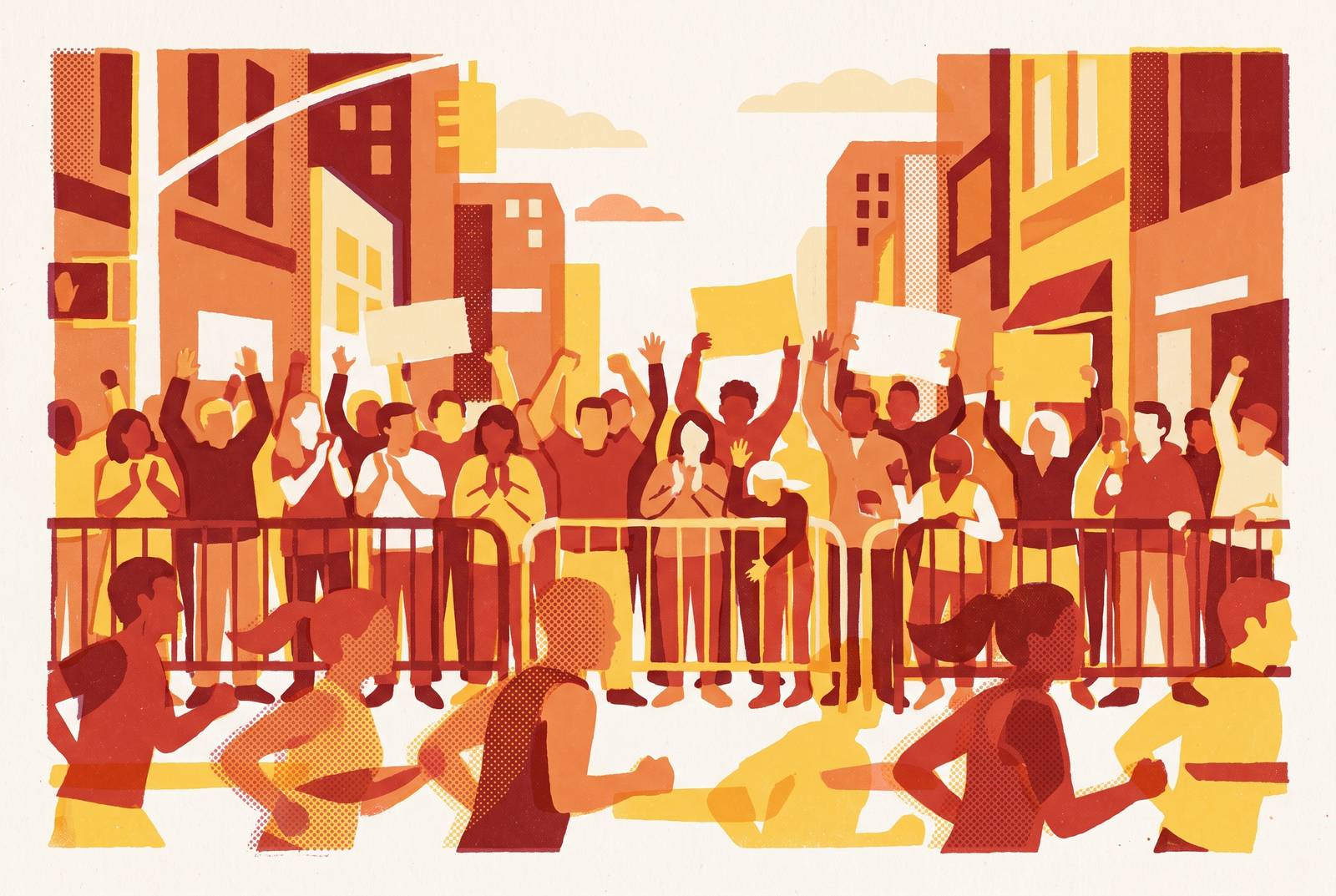
A marathon is not one event but a sequence of them, separated by miles that change what a runner needs from the people on the other side of the barricade. Where a spectator stands determines whether they witness the day or participate in it. The difference is not symbolic. It is the difference between a familiar face arriving when a runner still feels strong, and that same face appearing at mile 21, when the race has become a negotiation between the body and the will. Spectating is a craft, and the course is its material.
Why a spectator's position on the course shapes what a runner's race day feels like
The emotional geography of a marathon is uneven. A runner in the early miles is physiologically intact and largely self-sufficient, still calibrating pace against the day's ambition. The same runner deep in the back half is in a different state entirely, one in which the crowd's noise and a known face carry a weight no early-mile cheer can replicate. This is not sentiment. It is a consequence of what the marathon does to a body and a mind over twenty-six miles, and it means that the spectator's location is not a matter of convenience but of intention.
A spectator standing at mile 5 and a spectator standing at mile 21 are attending different races. The first is present for the opening act, when form is good and the finish is an abstraction. The second is present for the reckoning. Choosing between them, or planning to reach both, is a decision with real consequences for the runner. The spectator who understands this unevenness stops thinking of spectating as passive attendance and starts treating it as an active role, one that requires planning, transit literacy, and a sense of where the day's hardest truths will surface.
What race organizers actually offer spectators at the biggest marathons
The largest marathons have invested in spectator infrastructure that makes multi-point viewing possible, but the tools vary by race, and they only work for spectators who know they exist. Live tracking apps are the clearest example. The Chicago Marathon app lets spectators track their runner in real time by bib number, see estimated arrival times at each mile marker, and receive live updates at regular timing checkpoints. The Twin Cities in Motion app offers participant tracking alongside alerts on races, events, and participant milestones, and is available on the Apple App Store and Google Play Store. These are not conveniences. They are planning instruments that convert the chaos of thousands of moving bodies into predictable data points.
Course architecture affects spectator mobility as much as any app. Loop, out-and-back, and lake-circuit segments let a family catch the same runner two or three times without covering impossible distances. Amsterdam, Suzhou, and Wuxi are cited as examples of this design. Dedicated family zones, big screens, and landmark finishes, including Amsterdam's 1928 Olympic Stadium and Seoul's Jamsil Olympic Stadium, are structural features that change what a day on the sidelines feels like. Generous course cutoffs matter too. Atlanta closes its course at 2:25 p.m. and Richmond at 2:00 p.m., windows that give spectators waiting for back-of-pack runners a realistic day rather than an anxious one.
The Twin Cities Marathon is a concrete case of a race that publishes granular spectator information. Its official spectator page names iconic locations with their exact mile markers and the earliest expected arrival times for wheelchair athletes and marathon participants overall. That level of specificity, precise enough to plan a multi-stop day, is what good spectator infrastructure looks like when a race treats the sidelines as a population worth serving.
How transit and course geography determine whether multi-stop spectating is possible
A spectator who understands the course geometry and the transit network can see their runner multiple times. One who does not will see the runner once, from a fixed point, and spend the rest of the day waiting at the finish. The binding constraints on any multi-stop plan are physical: where the course runs, where the trains and buses run, and whether the two intersect at useful moments. Solving for those constraints is the actual skill of spectating.
The Chicago case is the clearest demonstration of what that skill looks like in practice. Following the suggested five-stop route through the city requires approximately 20,000 steps on the day. That is a serious physical commitment in its own right, and it would be impossible without a working knowledge of which viewing points sit near transit lines and which do not. The Twin Cities course design makes this mobility explicit in its official materials. Lake Nokomis Parkway at the halfway mark, Mile 13, is described as offering easy access to the Blue Line of the Light Rail. Transit is not an afterthought there. It is built into the course's spectator design.
The late-race cluster at Twin Cities shows why this matters. Summit Avenue, spanning miles 21.5 through 25, is where the gradual incline demands crowd energy. Cathedral Hill, miles 25 to 26, is the last chance to cheer before the finish. A spectator who understands the transit geography can be at the halfway point in the morning and on Summit Avenue in the afternoon. The runner's day changes as a result.
Where the course itself creates the moments that define race day for a runner
Some points on a marathon course are structurally dramatic, and a spectator who reaches them is present for a different kind of moment than someone standing at mile 5. Summit Avenue's "infamous gradual incline" is explicitly called out in Twin Cities official materials as the reason spectator presence there matters: runners will tackle the incline and need support. The J.J. Hill House is identified as the location of the Rainbow Mile Cheer Zone, a place designed for exactly that purpose. The course itself is asking for a crowd there.
Early-course spots have their own value. The Twin Cities guide notes that Douglas Avenue, miles 2 to 3, is where runners hit the lakes and encounter their first vertical climb. That is a fine place to be, and an easier one to reach. But the emotional calculus is different. Earlier is easier. Later is where it counts more. The point of spectating at a marathon is not to see the most running. It is to be present at the moments when a runner most needs to be seen.
Crowd character changes by neighborhood, not just by mile. At Chicago, Pilsen in the later miles has been noted for its neighborhood energy, including mariachi performances that have become part of the race-day experience. That atmosphere is a structural feature of the course, as much a part of the marathon as the mile markers, and it is available only to spectators who put themselves in its path.
What the finish line actually represents and why being there for it is different from every other point
The finish line is not the end of a race. It is the visible conclusion of a months-long story, and witnessing it puts a spectator at the moment when that story resolves. A marathon training build typically runs over sixteen weeks or more, and it reorganizes a runner's life. Scheduling, appetite, time with family and friends all bend around the training calendar. The people closest to a runner have already been part of the buildup. Showing up at the finish is the completion of a shared experience, not the start of one.
That completion carries specific logistical challenges. The finish area at a major marathon is the most crowded, most restricted point on the entire course. At Chicago, spectators are not allowed to escort runners to the start or greet them immediately at the finish. The designated Runner Reunite area in Grant Park opens at 9:30 a.m., and it is the correct meeting point. Planning the post-race reunion is its own task: knowing where the reunite zone sits, communicating a meeting point before the race, and accounting for the time between a runner crossing the finish and walking to that area. Even the emotional climax of the day requires operational forethought.
The scale of who finishes matters. At a race like a major city marathon, the finish draws elite runners, first-timers, charity runners, and athletes of every background. A spectator at Central Park is present for all of it simultaneously, for the professional finishing in a time the crowd can barely comprehend and for the first-timer discovering what 26.2 miles actually demanded. Being there when someone crosses that line is categorically different from seeing them at mile 5. It is the moment the race stops being a thing someone is doing and becomes a thing someone has done.
How race day connects to the weeks of training a spectator also lived through
A spectator who rearranged weekends, ran alongside a training partner, or simply absorbed months of early alarms and long-run Saturdays is not a neutral observer on race day. They are part of the story the runner is finishing. The marathon training arc is structured and consuming. It involves phases of aerobic base work, marathon-specific long runs that climb to distances simulating late-race fatigue, and a taper period that carries its own anxiety. It is not preparation that can be compressed or skipped, and it is not preparation that happens in isolation. The people around the runner live it too.
That shared history is why the right commemorative gesture after a marathon points back to the weeks of training, not just to the finish-line moment. The training is part of the race, not a prelude to it. And it is why a spectator's presence at mile 21, rather than at mile 3, resonates so specifically. The runner at that point knows whether the training held. The person cheering them through knows the cost of the work that got them there. There is no other place on the course where those two understandings meet so directly.
What a spectator can give a runner after the finish that honors the full arc of the race
Presence on the course and a lasting keepsake are not substitutes for each other. One is the live experience of the day. The other is how the runner carries the day's meaning forward. Both matter, and they matter in different ways. The race bib, the medal, and the finish-line photo all document what happened on race day. But the training that made the day possible, the GPS routes, the weekly mileage, the long runs that shaped the body for 26.2 miles, is harder to hold onto and equally worth marking.
The strongest commemorative gifts reflect the specifics of what the runner actually did: the course they ran, the time they finished, the training that got them there. Not a generic running motif that could apply to anyone. GPS data has made it possible to render a runner's actual route, not the official course map but the line their watch drew on race day, as a physical artifact. That line is theirs alone, and the weeks of training routes around it are equally specific to one person's experience.
A made-to-order object built from the runner's own data belongs to a different category of keepsake than something bought off a shelf. It carries the same message that standing at mile 21 carried: someone was paying attention to what this cost the runner, and it matters. That is the full arc of the spectator's role, from the first planning decision on race morning to the object that sits on a shelf months later. The craft of spectating is not only about where to stand. It is about knowing what the day means, and finding ways to say so that last.