The Ritual of the Pre-Race Expo
Months of solitary training finally become visible when runners pick up their race bibs.
By the time a runner walks onto an expo floor, the race has already been running for months, just not on a certified course. The early mornings, the long Sundays, the favorite socks, the GPS watch charged the night before: all of it accumulates into a private ritual that exists long before anyone else acknowledges it. That accumulation is what the runner is actually carrying when they arrive to pick up a bib. The taper in the final weeks before race day strips away the volume of training while leaving the accumulated effort fully intact, and the result is a runner who is rested in the legs but restless everywhere else, loaded with weeks of work and no outlet to spend it on. That unspent energy matters because it explains the emotional charge of the expo itself: a room full of people who have trained themselves into readiness and are now looking for somewhere to put it.
None of this is visible on a bib number. The reasons behind the training, whether it's recovering from illness, marking a birthday, running in someone's memory, or proving a point to no one but the runner, never appear on the race-day paperwork, but they shape every mile that gets logged in the build. That invisibility is part of why the expo functions the way it does: it's the first place where the work becomes legible to someone other than the runner who did it. The scale of demand for that experience has become its own kind of evidence. The 2026 London Marathon received a new world record for marathon applications, surpassing the prior year's record, and that surge says something concrete about how many people are willing to put themselves through months of early mornings and long Sundays just for the chance to stand at a start line.
How the expo converts private preparation into public ceremony
The bib is where that private labor stops being invisible. Picking it up is the moment the training converts from something a runner has been doing alone into something an institution has recognized, stamped, and numbered. That conversion is the real function of the expo, and it holds across every major race on the calendar.
The format repeats itself at race after race, which is part of what makes it feel like ritual rather than logistics. The TCS New York City Marathon Expo runs at the Jacob K. Javits Convention Center from October 30 through November 1, handling bib and packet pickup alongside hundreds of exhibitors, open to the public. Chicago's Abbott Health & Fitness Expo runs at McCormick Place, North Building, Level 3, Hall B1, at 2301 S. Martin Luther King Drive, Chicago, over three days, Thursday October 8 from 10 a.m. to 6 p.m., Friday October 9 from 9 a.m. to 6 p.m., and Saturday October 10 from 9 a.m. to 6 p.m., handling packet pickup for all marathon participants, free and open to the public. The 130th Bank of America Boston Marathon Expo takes over the John B. Hynes Veterans Memorial Convention Center at 900 Boylston St.: Friday April 17 from 10 a.m. to 7 p.m., Saturday April 18 from 9 a.m. to 7 p.m., and Sunday April 19 from 9 a.m. to 6 p.m., distributing bib numbers, race packets, and T-shirt pickup alongside an Adidas Boston Marathon store, sponsor exhibitors, and photo ops, all free and open to the public. The Austin Marathon's Health and Fitness Expo runs two days, Friday, February 13, and Saturday, February 14, ahead of the February 15, 2026 race.
A training log doesn't do what that bib does. A Strava file doesn't do it either. The bib is the first object from outside the runner's own head that names them as a participant, and in doing so it turns months of solitary preparation into something social, something an institution has put its name behind. That's the fulcrum the whole expo turns on: everything leading up to it lived inside the runner, and everything after it belongs, at least partly, to the public record.
What happens on the expo floor beyond packet pickup
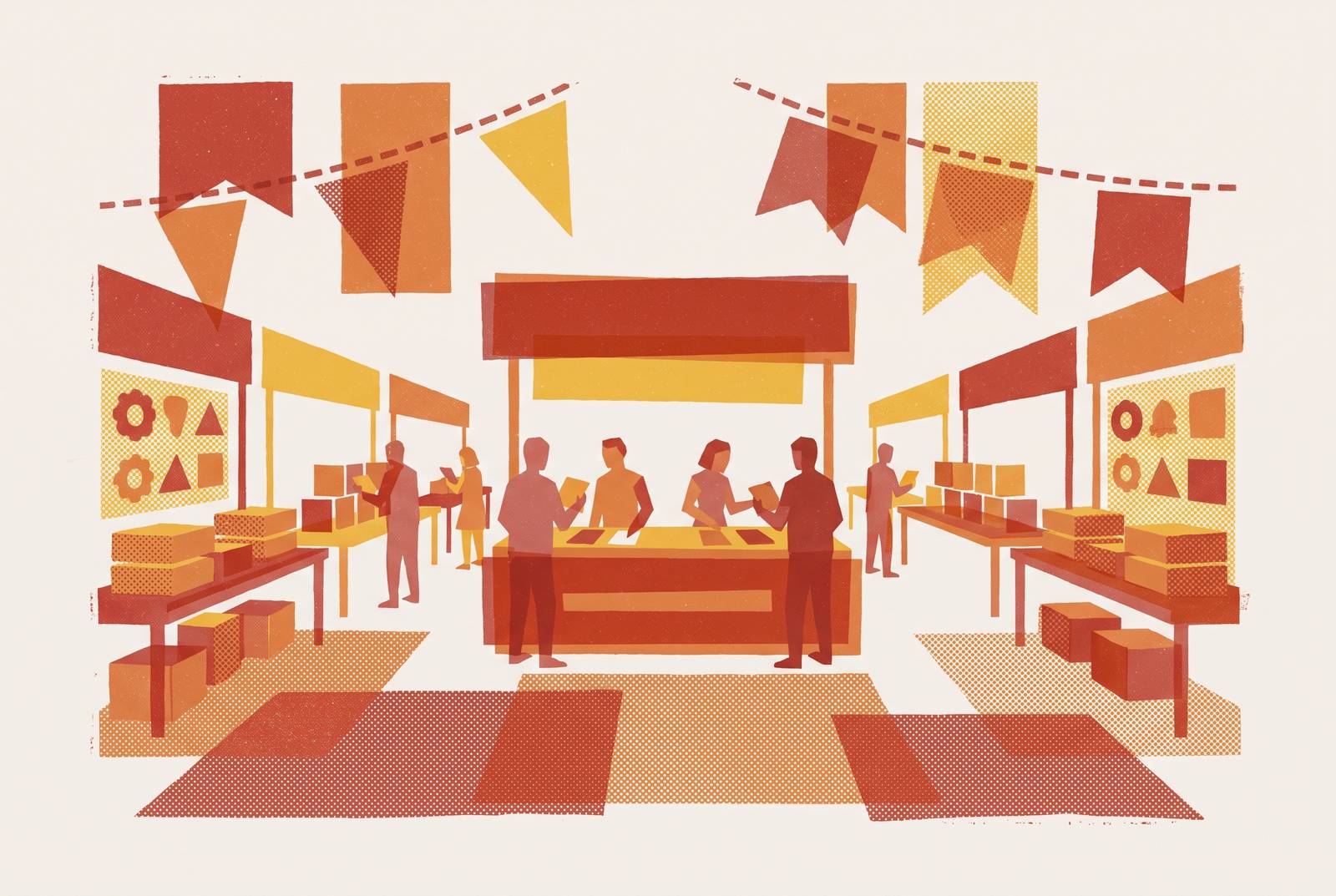
The floor itself is built to keep that charge alive rather than let it dissipate the moment the bib changes hands. Gear tables, nutrition samples, shoe technology, community meetups: the environment surrounds the pickup with enough to do and see that the runner stays in a state of anticipation the race morning itself, with its early alarm and narrowed focus, rarely offers in the same way.
Boston's programming at the 130th expo shows how far race organizers are willing to take this. Friday, April 17 alone carries a full day of scheduled sessions: an 11 a.m. panel titled "Running Smarter: AI, Data, and the Future of Human Performance," featuring Ami Bhatt MD, Abhishek Singh PhD, Trishan Panch MD MPH, Jaqueline Iversen, and Mariya Filipova, followed at noon by "Sacred Strides of Indigenous Running: Honoring the Past, Running for our Future," moderated by Larry Spotted Crow Mann. The day continues with an "Ali on the Run Podcast" session on up-and-coming Americans with Amanda Vestri and Annie Frisbie at 1 p.m., "Chasing the Legacy Star" with Conner Mantz at 2 p.m., a 3 p.m. panel on Boston Marathon nonprofits with Meb Keflezighi, Joe Andruzzi, Matt Brown, and Thomas Smith, a 4 p.m. conversation titled "Different Paths, Same Starting Line" with Scott Jurek, Daniel Romanchuk, and Alysia Montano, and a 5 p.m. session on running activism called "A Tale of Two Cities," covering Boston and Chicago. Saturday keeps the pace going with a 10 a.m. yoga session hosted by Adina Crawford, an 11 a.m. talk on "Boston Marathon at 130 Years" with author Paul Clerici, and a noon panel with elite athletes.
The threshold moment doesn't stay contained inside the convention hall, either. The Opening Ceremony on October 30 in Central Park extends it beyond the expo hall and into the city itself, with a Parade of Nations bringing runners from scores of countries together alongside live music and cultural performances. The Nike NYC Community Shakeout Run on November 1 offers something quieter: a relaxed short run along the Battery Park waterfront with pacers, check-in at 9 a.m. for a 10 a.m. start, filling the charged days between bib pickup and the gun with one more shared ritual. What makes the expo floor feel alive is the collision happening on it: runners are rarely more emotionally open than in the hours after they've picked up a bib with the race now imminent, and that same floor is where the commercial machinery of the sport, sponsors, vendors, merchandise, is at its most concentrated.
The expo as where the commemorative impulse first fires
Holding the bib raises a second, parallel question almost immediately: how does a person hold onto this. The expo is where that question first gets an answer, because it's also where the industry built to answer it first makes itself visible to the runner.
A major marathon organizer's own 2025 gift guide points directly at that instinct. The Official TCS New York City Marathon jewelry collection, designed by Erica Sara, is handcrafted and made to order, built specifically to honor the dedication, grit, and unforgettable moments of 26.2 miles. At the 2025 expo, the official marathon poster, designed by Brooklyn artist Gavin Snider, was available for purchase with the option to customize it with a runner's name, finishing time, and bib number, a commemorative object sold before a single mile of the race has been run, built entirely on the promise of what is about to happen. MarathonFoto extends the same logic past the finish line, turning race photos into plaques, prints, frames, and mugs that let runners hold onto the day in physical form.
None of this reduces to simple commercial appetite. Someone who buys or keeps one of these objects is recognizing the months of early mornings and long Sundays that no finish-line medal ever records. Critics who argue that this keepsake economy commodifies what ought to be an intrinsic achievement are pointing at something real, but the objection and the practice aren't actually in conflict: a physical artifact of a hard-won race carries the same power to hold memory that a trophy always has, and that's why the expo floor and the artisan market built around it keep growing together rather than one crowding out the other.
From medal to keepsake that holds the work
Every finisher crosses the same line and receives the same medal. What has grown up around that medal in the years since has moved in the opposite direction, toward objects valuable precisely because no two of them are alike.
GPS route art captures that shift clearly. It holds onto the geography of the effort, turning a runner's actual route into something that can be framed, gifted, or hung on a wall at home, and custom marathon map posters built directly from GPX data now function as keepsakes that record the specific course a runner covered, not just the distance they covered it in. The most effective version of this personalization uses GPS data, often pulled from a service like Strava, to map the exact run a person completed, with professional printing recommended for milestone efforts such as a first marathon or a long-awaited bucket-list race. That GPS data has become more centralized as a resource: in May 2025, Strava acquired the running app Runna along with the cycling app Breakaway, putting it at the center of the data that feeds both training analysis and the commemorative art built from it afterward.
Embroidered apparel tells a similar story about where the craft now lives. A custom marathoner sweatshirt featuring an embroidered laurel wreath around "26.2" above the wearer's name has collected thousands of reviews on Etsy, and a sweatshirt reading "MARATHONER CHICAGO 2026" with the runner's name and race year stitched onto the cuff shows that the appeal sits in the specificity of the details themselves. Nothing in this made-to-order model gets produced until the runner's own name, date, city, and finishing time are supplied, which mirrors what the expo itself represents: nothing generic changes hands there, only things that had to be earned first.
Boston's own expo programming suggests where this is headed next. The Friday panel on AI, data, and the future of human performance points toward training that is increasingly built from a runner's own individual physiology, shaped by analytics tuned to that one body. If the training itself is becoming this specific, the commemorative object built to hold it carries more weight than a finish time alone ever could, because what it's actually recording is the whole personal process behind that time.
Giving someone a piece of their own effort back
The runner isn't the only one who was there for months of early mornings and long Sundays. Someone else usually watched it happen too, through favorite socks laid out and a GPS watch charged the night before, in a private ritual that predates any public acknowledgment. A personalized gift for a runner does more than put a name on a mug or a print. It takes a simple object and turns it into a tangible piece of that runner's story, and in choosing it, the giver is recognizing the exact stretch of months that shaped someone else's mornings and Sundays without ever touching their own.
The range of objects built for this now spans custom route map prints, engraved medal hangers, commemorative ornaments, handcrafted jewelry, photo packages, and embroidered apparel, and all of them point toward the same purpose: giving permanent, physical form to work that would otherwise stay invisible. Personalized marathon map prints that incorporate a runner's bib number, name, finish time, date, and distance rank among the most reviewed products in the category: the bib number shows up again, the same object a runner first held at the expo, now built into something meant to last well past race day.
The training was never separate from the 26.2 miles. The weeks that rearranged a person's mornings, their Sundays, their conversations with everyone around them, are part of the race itself, not a prelude to it, and a commemorative object that holds both the course and the buildup is recording the whole thing rather than just the one day. It starts at the expo, the moment a runner holds a bib and the race turns real, because something in that moment starts looking for a way to make the whole effort permanent. The objects built to answer that search are at their best when they're as specific and as unrepeatable as the months of work they're standing in for.
Sources
- Boston Marathon Expo - Boston Athletic Association
- RACE WEEKEND EVENTS - Bank of America Chicago Marathon
- Austin Marathon
- New York Road Runners Brings TCS New York City Marathon Race Week to Life with Events, Offers and, Experiences
- GPS Route Art: Visualize Your Journeys in 2026
- Marathon Embroidered - Etsy
- Your Complete Guide to the 2026 Boston Marathon Expo Live Stage
- 2026 London Marathon