What Runners Wish They Had Done to Mark a Finishing Moment
Runners wish they'd recorded the training months that made their finish possible.
A race keepsake can record a finish without preserving much of what it meant. What runners wish they had done to mark that moment points to a clear conclusion. The most complete commemoration holds both the course they finished and the training that made the finish possible, with enough personal detail to distinguish their effort from everyone else’s.
Why finishing a race leaves most runners with less than they expected
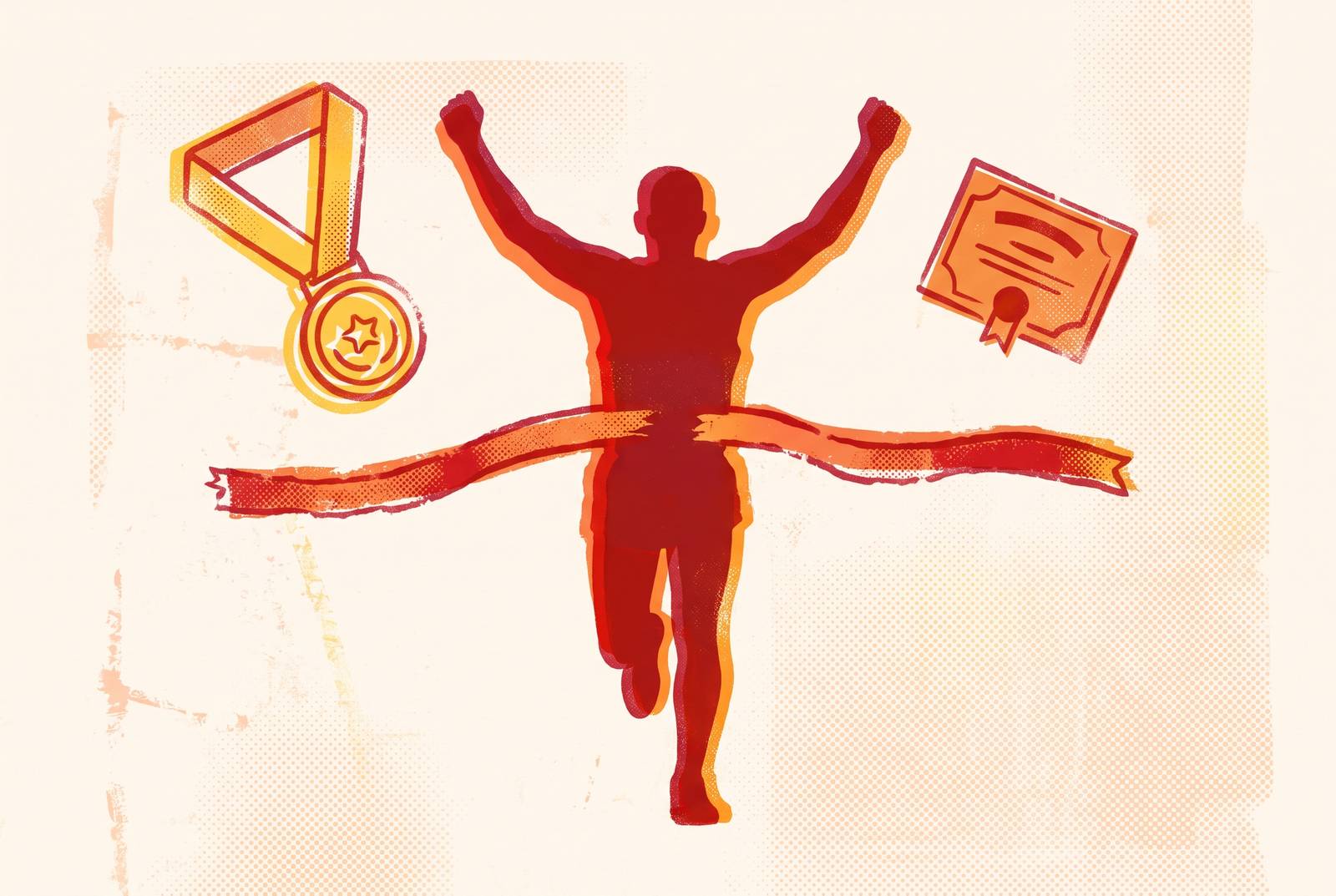
Just after finishing, a runner can look down at the medal and find that it says very little about what has happened. It shows that the runner finished, but not how much work it took. The runner has crossed the finish line in seconds, before it has all sunk in. What remains is an object made to represent a shared event, when the runner has just completed something deeply individual.
That difference matters because the race has occupied much more than the day itself. For months, it has shaped when the runner eats and sleeps, how they travel, and how they think about themselves. A schedule that once sat around the edges of ordinary life has become one of its organizing structures. Crossing the line completes the event, but it does not gather those changes into a form the runner can keep.
Roughly 16 to 20 weeks of increasing mileage, long runs of 16, 18, and 20-plus miles, and a taper lead to one finish line. Yet the medal every finisher receives is identical regardless of what each runner went through to earn it. Its generality is useful as a symbol of the race and limited as a record of the person. The asymmetry is months of effort reduced to one identical object.
What the training weeks actually contain and why they disappear
The training block is where much of the change happens, although it leaves the fewest physical traces. Early on, mileage climbs and habits begin to form around the schedule. The runner’s identity shifts with those habits, as the race becomes less of a distant intention and more of a daily commitment. These weeks do not have the clear boundary of a finish line.
The first long runs into double-digit miles give that change a more definite shape. Each tests aerobic base, pacing discipline, and nutrition strategy, but each is also a small event of its own. A run has a route, a feeling, and a particular demand that its distance alone cannot express. By peak week and the 20-miler, the question has become whether the runner is ready. That run matters both for getting the body ready and for building belief in what comes next.
Then the taper changes the character of the days again. Mileage drops while doubt rises, and the body recovers while the mind races. This is still part of the experience, even though doing less can make it harder to recognize as work worth recording. A finish-line artifact has no natural way to distinguish these phases.
The record often exists, but in a different form. GPS watches and apps like Strava and Garmin log time, distance, pace, and route, leaving a detailed account that most runners never turn into anything physical. The reasonable objection is that training still feels vivid enough to remember without help. Yet vivid recall fades, and specifics such as the route of the 18-miler, the exact week mileage peaked, and the number of runs in the block are the first to go. The data sits in an app as time passes and memories lose their detail.
The specific things runners wish they had done, named honestly
The first regret can begin before the first training run. Runners wish they had written down why they signed up, in the terms that made sense at the time. That original reason can shift during training, and the explanation available afterward may no longer be the one that started everything. A finish time cannot recover it. Neither can general advice to record the journey, because what has been lost is the reason for starting, which a full account of every day may never capture.
The same distinction applies to the long runs. What runners miss is not necessarily another record of split times, but a few words about what happened, how the run felt, and what it cost. The runner can still name the distance easily, even as it gets harder to recall how the run felt. There is a related regret in leaving training GPS data unexported while saving only the race-day route. Those repeated training routes are part of this particular build.
The gear laid out, the early alarm, and the particular quiet of a start-line morning can seem too immediate to need a photograph or description. Afterward, those are precisely the details that distinguish the morning from a result on a screen. Having relied on the race’s official photos, runners also wish they had asked someone to photograph them crossing the line. The regret is not simply a shortage of images, but the absence of the image they wanted to keep.
Immediately after finishing, there is often something more urgent than writing. Yet runners later wish they had put down even a few sentences about the last miles while the details were still present. The bib presents a smaller, more tangible version of the same problem: keeping it somewhere intentional can be overlooked as it stays in a bag or is thrown away. In the days that follow, runners miss the chance to order a keepsake. Runners wish they had ordered something made from their course route, elevation, or specific splits while they still felt strongly about the race.
Underneath these omissions is a wish for something that identifies the finish as theirs through a bib number, time, date, and course. For runners travelling to Tokyo, Boston, or London, the bib can function as a passport and the medal as a souvenir. Neither, however, carries the course itself, the time on the clock, or the weeks that made the journey possible. Running treated as ritual calls for a relic that preserves more than participation. Without that record, it gets harder to keep sight of what makes a ritual meaningful beyond being a habit.
What the commemoration options that actually exist look like, and what each one holds
GPS route art preserves the shape of the course and its connection to a place, often with personal race-day details. The Personalized 3D Race Map | Custom Running Route Wall Art | GPX Map has a listed price of $149.00. The Custom Race Map Print, Any Marathon Half 10K Triathlon, Strava GPX Route Poster, Personalized Finish Time, First Marathon Runner Gift is listed at $25.00 with free shipping. These options make the route visible, but do not hold the training weeks or the body that wore the bib.
Bib-and-medal frames and shadow boxes start with the objects the runner already has. The Marathon Medal Display Frame from Mrkyourmoment has a listed price of $105.00, and the TCS Sydney Marathon Medal Display Frame – Official 2025 has a listed price of $104.00. The frame brings the bib, medal, and a photograph together to keep a record of race day. GPS data and training context remain outside what the display holds.
The Running Bucket List Map, CUSTOM The ORIGINAL Viral Running Map, Marathon Travel Map, Gift for Runner has a listed price of $99.00 with free shipping. This kind of map records the geography of a runner’s race history across cities or states. Its emphasis is forward-facing and aspirational rather than concentrated on the meaning of one finish. It answers where a runner has raced, or hopes to race, rather than what a particular training block required.
Trail and ultra run prints also belong in the range of commemorative formats, while embroidered and textile keepsakes offer a different material approach. Etsy’s personalized marathon bib market includes the custom “Marathon Runner Custom Race Bib Embroidered Hoop Ornament Memento” among its newer craft entries. Embroidery brings a tactile, handmade quality associated with heirloom objects. Its material carries connotations of permanence and care, giving a bib-based memento a different character from a printed image. That quality matters in its own right, however much the keepsake tells about the race.
Embroidered shorts extend the textile approach by carrying the course on one leg and training data on the other. Here, the medium and the content both change, because the keepsake is wearable and the record reaches back before race day. It can return to running. For a finisher or gift-giver, the important distinction is therefore what each format is built to hold.
Why the training block belongs on the keepsake, not just race day
The unresolved gap is the buildup. Most race-day keepsakes commemorate completion, while almost none commemorate the weeks in which the runner’s habits, readiness, and sense of self changed. That is a limit on the story an object designed to display a medal or a course can tell. If the aim is to preserve what the finish meant, the training block belongs within the record.
The useful starting point already exists in Strava, Garmin, or a GPX file. The data has both the race course and the training runs that came before it, including the 18-miler, peak week, and total miles logged. There is no need to reconstruct the whole buildup from memory when that record is available. Making a keepsake from it takes the data out of the app and puts it into something the runner can keep. The practical distance between finishing and having something made from that record can be a matter of days and a few uploaded data points.
A piece that places the course on one side and training weeks, miles, and runs on the other makes the relationship explicit. One part identifies race day, while the other accounts for what it took to arrive there. Wearability adds a further distinction because the object can go back out on the next long run. The record of a completed effort then accompanies the continuation of the practice.
There is also an answer here to the concern that personalized keepsakes make hard-won finishes seem equivalent to casual participation. A record built from a specific bib number, finish time, date, training block, and GPS route is individual by construction. The final action is correspondingly specific and best taken before the feeling fades. Export the data, approve the proof, and wear the evidence of the work before the next race asks for it again.