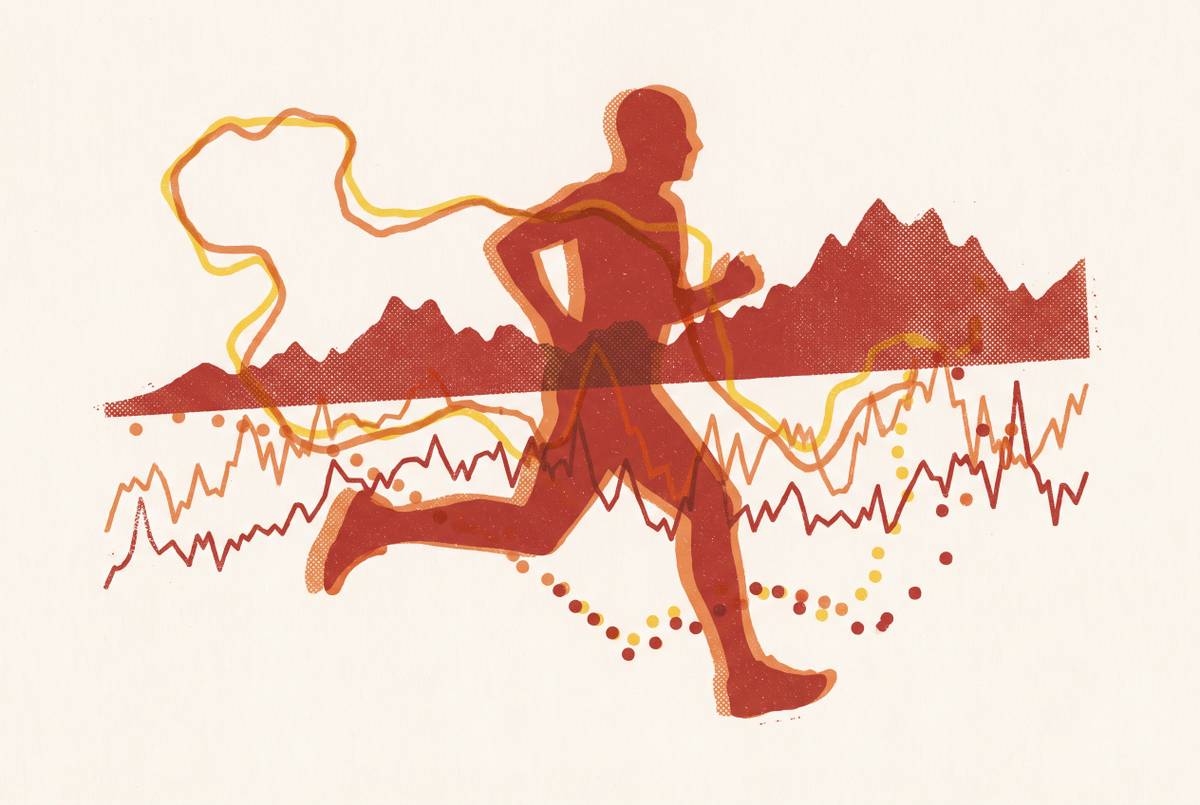
What Taper Madness Actually Feels Like
Months of training create an identity that taper systematically dismantles.
The last long run of peak week ends the way the best ones always do: legs heavy, watch showing a number that would have seemed impossible four months earlier, and a quiet certainty that all of it, the alarms, the midweek tempo runs, the Sunday mornings given over to twenty miles of pavement, has added up to something real. That certainty is the product of 12 to 20 weeks of training and is the organizing structure of the whole experience. A marathon buildup does not simply condition a runner's heart and legs. It constructs a self-concept, built week over week on volume, effort, and ritual, until the runner's sense of who they are becomes inseparable from what they do before sunrise.
That buildup moves through distinct phases, base, build, peak, taper, and peak week sits at its summit: the longest run, the hardest workouts, the highest mileage of the entire cycle. It is the point at which months of accumulated proof culminate in a single, undeniable data set confirming the runner's fitness. And it is precisely that peak, that highest-water-mark version of the self, that the taper begins dismantling within days.
Why cutting volume feels like losing yourself
Taper madness is what happens when the structure that has organized a runner's identity for months is suddenly withdrawn, and the self built on top of that structure has nowhere to stand. Sports psychologist Jim Taylor has described the mechanism directly: during a long training period, runners become addicted to the intensity and the volume, it becomes their norm, and changing that volume and intensity is disruptive psychologically and emotionally, not merely in terms of physical output. The word "addicted" is doing real work in that sentence. It names a dependency on a pattern of behavior, not a dependency on exercise for its own sake.
Consider what the taper actually removes. It is not just the runs. The 5 a.m. alarm disappears. The long run route, memorized turn by turn, goes unused. The training group that met every Saturday scatters. The specific, bone-deep exhaustion that followed a twenty-miler, which for months served as evidence of effort and forward motion, stops arriving. Every one of those things functioned as a marker of progress, and every one of them vanishes in the same two-week window. A runner does not lose a workout schedule. A runner loses the apparatus that told them, daily, who they were becoming.
This framing matters because it changes what the runner is actually dealing with. Taper madness is a rational system, built and reinforced over months, responding accurately to the sudden absence of the structure that fed it. The system is doing what any well-trained system does when its inputs disappear: it reacts.
What the body is doing while the mind unravels
The physical sensations of taper, the heaviness, the twinges, the unfamiliar aches, feel like deterioration because they are unfamiliar. The body during taper is doing precisely what the training was designed to let it eventually do: absorb, repair, and store. Those processes have simply never had room to happen before, because the training block never stopped generating new stress long enough for them to complete.
One clear example is glycogen supercompensation. Research published in the Journal of Applied Physiology shows that muscle glycogen concentrations rise during the first week of tapering, as the body, no longer burning through its fuel stores daily, begins stockpiling them instead. Glycogen binds with water, and the result is legs that feel dense, swollen, and heavy, a sensation many runners misread as lost fitness or a body somehow falling backward in its final weeks. The heaviness is stored fuel accumulating for race day, not strength draining away.
Muscle repair works on a similar principle. Continuous training interrupts the repair process before it ever finishes, since damaged fibers barely begin healing before the next hard workout asks something new of them. The taper, for the first time in months, gives the body an uninterrupted runway: fibers rebuild, inflammatory markers clear, connective tissue strengthens. That repair process produces its own sensations, odd twinges, brief aches in places that were silent during training, and those sensations can feel alarming precisely because the runner has never been still long enough to notice them before.
The phantom pain phenomenon that follows has two overlapping explanations. The immune system, which heavy training blocks tend to suppress, begins reactivating and addressing inflammation that had been deferred for months. At the same time, with less fatigue to mask ordinary sensation and fewer workouts demanding focus, runners become hyperaware of muscular signals that were always present but never registered. The irony sits at the center of the entire taper experience: the body is filling up, strengthening, and sharpening toward its best performance, while the mind, parsing unfamiliar signals with no context for them, interprets each one as evidence of collapse.
The mood crash and the phantom pains
The calf twinge at 3 a.m. The sudden, serious urge to sneak in one more 20-miler despite a taper plan that explicitly forbids it. The compulsive opening of a weather app for a race still ten days out. Irritability can appear over something as small as a dinner reservation. None of these are signs of a runner falling apart. They are the predictable residue of a system that spent months generating output and has suddenly been told to stop.
The mood crash has a neurochemical basis. Long runs and hard tempo sessions supply a steady, near-daily flow of endorphins that help regulate mood, energy, and a runner's general sense of wellbeing. When training volume drops sharply, that supply drops with it, and the result resembles a mild withdrawal. Sleep disruption, short tempers, obsessive race-day research, and the recurring itch to search online for whether one more long run could possibly help are not separate symptoms. They are variations on a single phenomenon: a brain that has spent months directing enormous energy toward a goal, now searching for somewhere to put that energy and finding nowhere to send it.
Research on endurance athletes bears this out directly: when training volume is reduced by more than a third during taper periods, anxiety levels rise significantly. The relationship is proportional. Runners who invested the most, who built the biggest base, hit the highest peak mileage, and organized the most of their daily life around the training block, tend to feel the taper's absence the hardest, because they have the most riding on what the taper takes away.
Not every runner experiences taper madness in equal measure, and some move through it with no real disruption. That outcome reflects a shorter training buildup, a lower emotional investment in that particular cycle, or an existing structure, family, work, other serious pursuits, that the training never fully displaced. The runners who feel taper madness most acutely are not weaker than those who don't. They simply built something bigger to lose.
Why knowing the mechanism helps
Understanding why taper madness happens functions as one of the most effective tools available for getting through it, because it turns an unfocused, irrational dread into a process with a clear beginning, middle, and end. A runner who understands that the leg heaviness is glycogen storage, that the 3 a.m. twinge is repair work rather than injury, and that the restlessness is a motivated brain without a task, is a runner equipped to sit through those two weeks rather than fight them.
That understanding also changes what the taper is, structurally. It is the final phase of a months-long process, one with its own essential work, even though that work no longer looks like mileage on a training log. The runner who treats taper as dead time, an obstacle between them and race day, is working against the exact biological processes that will determine how they perform. The runner who understands taper as the phase where glycogen stores fill and muscle fibers finish repairing is working with those processes instead.
The practical implication follows from the identity argument laid out earlier. What a taper-struck runner needs is not more miles and it is not an aggressive cross-training substitute designed to fill the hours. What's needed is something to do with the meaning that months of training built, a way to hold onto the structure and the identity without undoing the taper's physiological purpose by adding volume back. The guidance on structure itself is simple: reduce volume, preserve intensity in the workouts that remain, and resist the temptation to sneak a hard effort back in during the final week. The taper works when a runner trusts it. It stops working the moment a runner overrides it out of anxiety.
Sleep is the single most powerful tool available during this window, and it happens to be the one most runners neglect. Research on sleep extension shows measurable improvements in mood, reaction time, and endurance performance, and the taper, with its sudden surplus of free hours and reduced physical demand, is exactly when extra sleep becomes most accessible. The anxious energy flooding in to fill the space training used to occupy is preparation energy that has not yet found its outlet. Race day is that outlet. The taper is simply the compression before the release.
What the training actually was
Marathon running, as researchers have come to understand it, is not reducible to a completed distance. It functions as a multi-dimensional experience encompassing perceived challenge intensity, emotional reward, personal growth, goal orientation, and flow. What runners report afterward is a deep sense of personal achievement and meaning, built across dimensions that have little to do with the clock.
Most of that meaning was made before the starting gun ever fired. The weeks of base-building, the long runs completed alone before dawn, the workouts survived on tired legs, and the slow accumulation of a fitness and a discipline that did not exist four months earlier are where the runner actually changed. The race itself is a single morning's expression of work that was already done.
Taper madness, understood this way, is the cost of having built something worth protecting. The withdrawal symptoms, the heavy legs, the mood swings, the sleepless nights spent half-dreading and half-craving the start line, are proof that the training mattered enough to leave a mark when it stopped. A runner crossing the finish line receives a medal for the race. But the race is one morning. The training, the route run a hundred times in the dark, the weeks of work that made the finish possible at all, constitute something the medal was never built to hold.