Ultra Running Culture vs Marathon Culture
Marathon runners chase times; ultrarunners chase the finish line and the story.
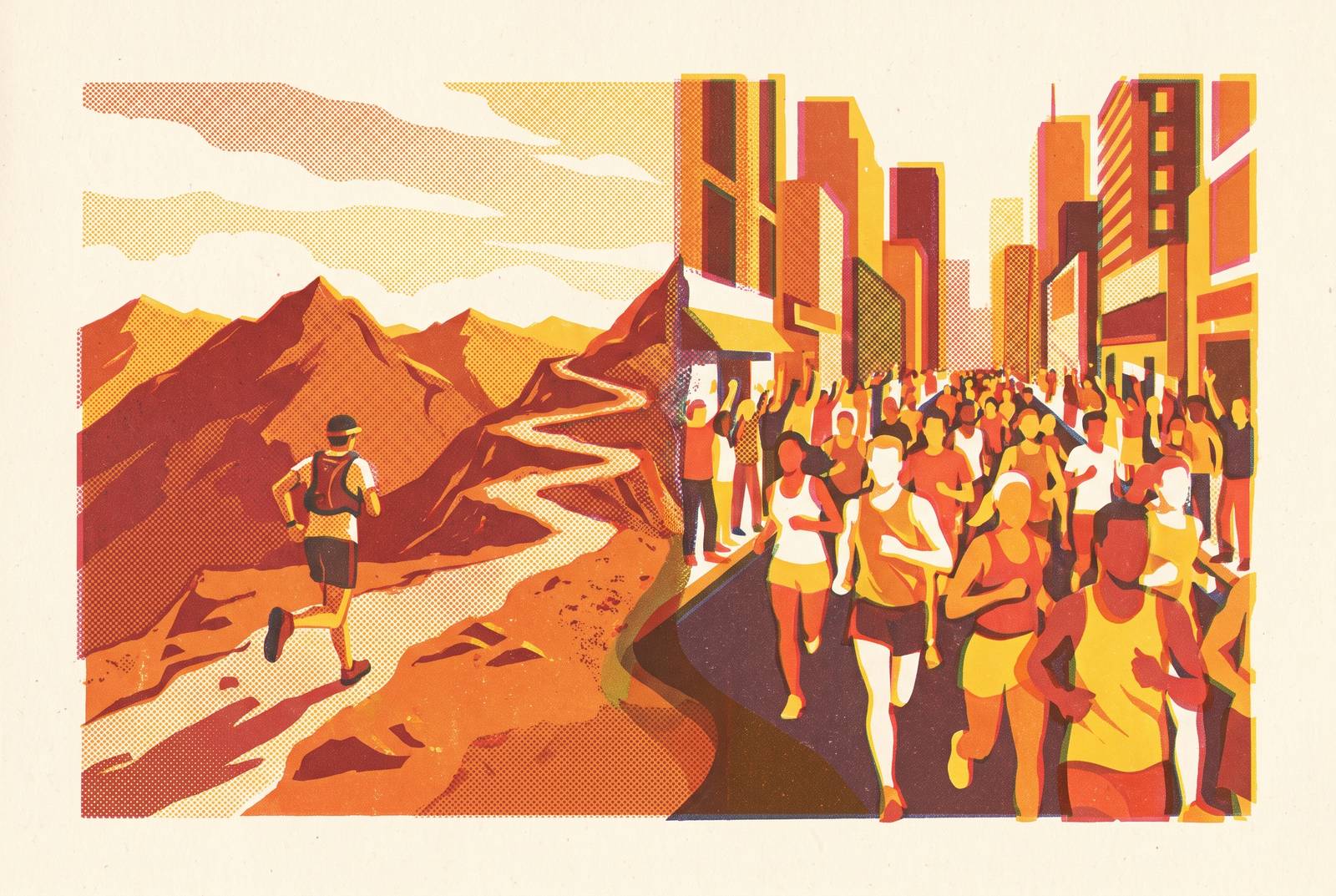
The marathon has built its entire culture around a clock. Whether the race is run through the streets of California or the hills of Virginia, a finish time means the same thing everywhere, and that portability is what makes marathon running legible as a shared pursuit rather than a private one. One major marathon's own guide for runners states it directly: in a marathon, much of the focus is on pace and finish time. That emphasis is not an accident of culture so much as a product of how the sport trains people. Marathon training plans place significant weight on running at or near race pace, and UKRunChat's overview of the sport notes that speed work is specifically designed to help runners sustain a relatively fast pace across the full 26.2 miles. Every tempo run, every lactate threshold session, every interval workout exists to make the clock move faster on race day.
That structure produces a particular way of thinking about effort. A marathon finish time is legible, rankable, and directly comparable to the finish times of millions of other runners, and that comparability is a large part of the sport's appeal. It is what makes a qualifying standard for a major marathon meaningful, what gives age-group rankings their weight, and what turns a personal record into a milestone worth chasing again. Walking breaks carry a cultural stigma in marathon training circles precisely because they represent a surrender of pace, which in this culture functions less as a tactic and more as a value statement about what the runner is trying to prove. None of this diminishes the difficulty or the meaning of running 26.2 miles. It simply means the sport has organized its rituals, its training methods, and its emotional vocabulary around a single transferable number. That number is what lets a stranger understand a marathon finish in a single glance, and it is what makes marathon culture so easy to read from the outside.
Ultra Running's Different Question
Ultra running did not simply extend the marathon's logic to a longer distance. It replaced the marathon's central question with a different one. The SF Marathon's own guide draws the line directly: the big difference between marathons and ultramarathons is a mindset shift, not just a mileage increase. In an ultra, runners emphasize time on feet, steady pacing, fueling early and often, and the kind of problem-solving that only occurs when a race goes sideways for hours at a stretch. Technically, any race beyond 26.2 miles qualifies as an ultramarathon, though in practice the shortest commonly recognized ultra distances begin just past the marathon mark. What actually unifies the category is not a number on a course map but a demand: the ability to keep making sound decisions while fatigue compounds hour after hour.
That demand shapes what the sport rewards. The SF Marathon's guide describes problem-solving as a core ultra skill, pointing to blisters, temperature swings, GI issues, and gear tweaks as the kinds of mid-race crises that separate runners who stay calm from those who unravel. Power hiking up a mountain section is not a failure in this world. Even elite ultra runners hike the steep climbs, because the sport's value system rewards the finish and the judgment that got a runner there, not a sustained pace that ignores terrain. That value system is visible socially as much as physically. Blue Ridge Outdoors has described even top ultra competitors gabbing, joking, and encouraging each other mid-race, a detail that reflects how tight the ultrarunning community is, in contrast with the more individually focused atmosphere of a large road marathon. Aid stations become the physical expression of that culture: not just a table of water and gels, but a gathering point that generates its own shared lore, the stories runners tell afterward about which station had the best food, the best volunteers, the best energy on a hard day.
What each culture asks when you cross the finish line
The question people ask at the finish line reveals how differently these two cultures think. The SF Marathon's guide frames the contrast directly: in a marathon, people most often ask what your time was, while in an ultramarathon, they ask whether you finished, and how you managed the challenges along the way. That single difference in phrasing carries an entire value system inside it. A marathon finish time locates a runner inside a national distribution of performance, measures their progress against a previous attempt, and either validates months of training or sets the target for the next cycle. An ultra finish gets measured by a different standard: finishing steady, staying consistent, avoiding a major blow-up, and managing body and mind well enough to see the race through. What a runner remembers afterward is the story of how they got through an ultra, not the number attached to it.
It is worth acknowledging that plenty of marathon runners care first and foremost about finishing, not about their time, and the ultra world's belt buckles and pint glasses, handed out as finisher tokens at many trail races, carry their own wry humor precisely because they signal something unusual and communal rather than a specific performance. But the infrastructure each sport has built around itself tells a different story than any individual runner's motivation might. Marathons are built around qualifying standards, pace corrals, age-group rankings, and a finish-line clock positioned as the race's visual centerpiece. Ultra races have no equivalent infrastructure organized around time. That structural gap is not a minor detail. It shapes what runners remember about their race, what they feel compelled to commemorate afterward, and what any gift or keepsake needs to say in order to feel true to what actually happened out there.
How training culture embeds each sport's values before the race begins
The values each culture holds do not appear only on race day. They get built, rehearsed, and reinforced across months of training long before either runner reaches a starting line. Marathon training typically follows a roughly 16-week macrocycle structured around pace targets, tempo runs, interval sessions, and mileage benchmarks. The clock is present from the very first training run, not just on race morning. Blue Ridge Outdoors has described marathon training bluntly as a grind: long runs on roads, routes chosen mainly to rack up necessary mileage, a relentless focus on pace, and a cultural disapproval of walking breaks. Road running's repetitive motion also carries a cost. Blue Ridge Outdoors notes that the rate of repetitive stress injuries is very high in marathon training specifically, a consequence of pounding the same mechanical pattern over and over on pavement.
Ultra training looks almost nothing like this. Its long runs happen on trails, often at a slower pace and in the company of friends, with runners stopping for photos, waiting for each other at trail intersections, and planning snack breaks at a summit or a swimming hole along the way. Blue Ridge Outdoors captures that contrast with a heading that reads, simply, "Marathon training is often a grind, Ultra training rocks!" Hannah Walsh Coaching notes that ultra training typically includes back-to-back long sessions, a hard effort on Saturday followed by another on Sunday, designed to build confidence running on tired legs and to simulate the fatigue a runner will face deep into race day. UKRunChat, drawing on Hal Koerner's Field Guide to Ultrarunning, makes a related point: ultra training is not about stacking on miles mindlessly, but about shifting the focus toward back-to-back long runs that rehearse the specific fatigue an ultra will demand. Marathon training rehearses pace. Ultra training rehearses patience, judgment under fatigue, and the management of discomfort over many hours, and in both cases the training itself builds the exact skill the race is designed to test. Regardless of which culture a runner belongs to, the training period, not race day, is where the emotional weight of the whole effort actually accumulates: the early mornings, the long runs in bad weather, the small decisions made week after week that eventually add up to a finish line. A medal or a clock time was never built to hold any of that.
Why the object you get at the finish line rarely captures what the finish meant
Every marathon finisher who crosses the line receives the same medal as every other finisher that day, and that sameness is precisely what limits what the medal can say. It marks the distance covered, not the particular emotional or physical route a runner took to get there. None of this is a case against medals, which carry real and lasting meaning for a great many runners who display them proudly for years afterward. But the marathon's emotional stakes, built up over months of preparation and expressed publicly in front of crowds, are large enough that a generic medal often feels insufficient against what the runner actually went through to earn it. The specific course, the weather that day, the internal low point somewhere around mile 20, the moment something held when it could have broken: none of that is visible in an object that every single finisher in the race receives in identical form.
Ultra culture's belt buckles and pint glasses do a bit more work here. They at least signal something unusual and communal, a shared understanding among people who know what finishing an ultra costs. But they still don't individualize a runner's particular day. They say nothing about which aid station broke a runner open emotionally, or which climb got power-hiked in the dark with a headlamp. The objects that resonate most with finishers from either culture tend to be the ones that individualize a shared experience, a customized map, an engraved date, something built from the runner's own data, because an object like that says this was your race, not merely you finished this race. Race bibs carry a version of this same emotional charge; plenty of runners keep theirs because it represents the specific day, the specific weather, the specific struggle. But bibs are paper. They fade, they tear, and most of them end up folded into a drawer rather than displayed anywhere. The space between what a finish actually meant to the runner and what the standard keepsake manages to communicate is exactly where the most meaningful mementos get made.
How GPS data became the most personal record of a race
A runner's GPS trace is the only record of a race that captures its actual geography: every turn taken, every climb endured, the precise course run that day, no two of which are ever identical even on a certified course. That specificity is what makes GPS data the most personal raw material available for commemorating a race. A GPS file pulled from a service like Strava, or uploaded directly as a GPX file, preserves the route exactly as the runner ran it, not a generic map of the course but their own trace, detours and variations included. Companies like RoutePrinter and Mark Your Moment have built entire product lines around turning that data into something physical, converting a Strava or GPX file into a printed map a runner can frame and hang on a wall. A major marathon course has even been sold as an embroidery listing built directly from a runner's GPS course, a concrete example of GPS data and craft combined into a single wearable object.
For runners, GPS route art occupies a genuine sweet spot between a performance record and a personal memory. It keeps the actual geography of the effort intact while rendering it in a form a runner can frame, wear, or give to someone else. That quality matters even more for ultra runners, because no two ultra courses are identical in the way road marathon courses tend to be. The terrain, the elevation profile, the trail itself vary so much from race to race that an ultra runner's GPS trace is genuinely singular in a way a road marathon course map simply is not. For both cultures, that GPS trace captures something beyond the finish line itself. It holds the record of the entire route that the months of training were built to prepare a runner for.
Why embroidery on running shorts is a different kind of keepsake than a print on a wall
Embroidery stitched into something a runner actually wears keeps the race present in the ongoing act of running rather than retiring it to a wall. A printed map fades and peels over time, while embroidered stitching holds up through repeated washes, a difference that is structural to the two materials rather than a claim made for marketing purposes. A framed print commemorates a finish by removing it from the physical act of running. A wearable keepsake does something closer to the opposite: it carries the race forward into the next long run, so that the training and the finish both become part of the gear a runner trains in going forward. Embroidery's made-to-order production process reinforces that same personal quality, since nothing gets produced until a specific design tied to a specific runner's course has been confirmed, rather than pulled off a shelf from existing stock.
That relational texture of ultra culture, the sense that a race is something lived alongside others rather than simply measured against them, shapes what an ultra finisher actually wants to hold onto afterward. A keepsake suited to that world needs to honor the specific route, the place where the race happened, and the person who ran it. Laurels creates that kind of one-of-a-kind object by embroidering shorts with a runner's actual GPS course, turning the race itself, not a finish time, but the terrain and the effort behind it, into something wearable and particular. In ultra culture, the finish-line question is about the experience itself, how a runner managed the challenges, what they discovered about themselves along the way, and a fitting keepsake for an ultra finisher should capture the route and the training that led there rather than stand in as a simple completion marker. GPS-personalized apparel honors that specificity by embedding the actual course a runner covered into something they can put on again. Marathon and ultra culture may ask different questions at the finish line, but both point toward the same conclusion: the object worth keeping is the one that remembers the particular route, not just the fact that it was run.