How to Get Your Marathon Route Embroidered on Running Shorts You Will Actually Wear Again
Turn your marathon GPS route into embroidered shorts you'll actually wear on runs.
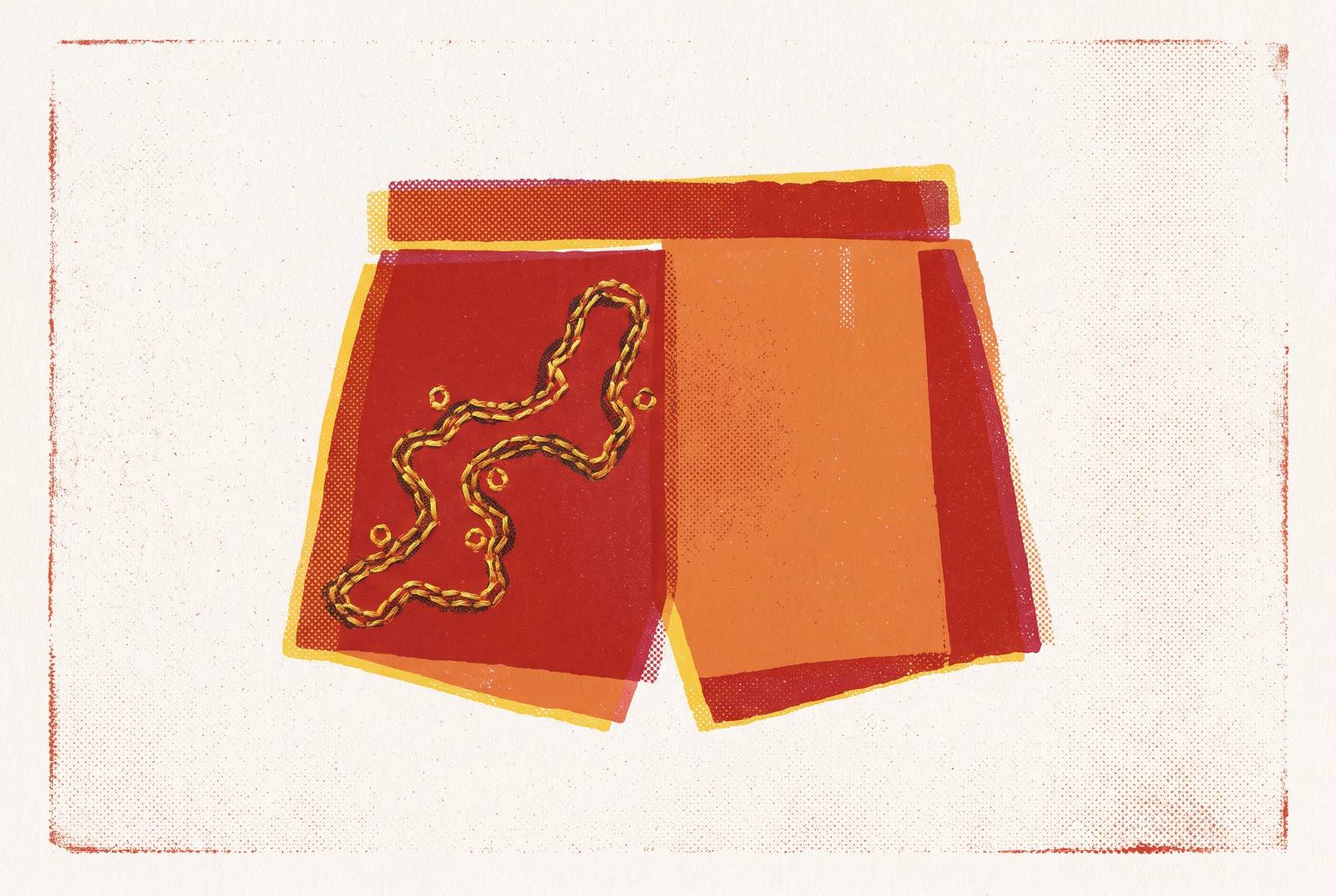
Running shorts embroidered with the finisher’s GPS route are a personalized gift for a marathon finisher who wants to use the keepsake. The process turns the recorded course into a simplified stitch design, with training data making the pair specific to the runner. The decisive choices are the route, the fabric, and an approved proof that makes the design readable at leg-panel scale.
Why most marathon keepsakes end up on a shelf and stay there
The medal hangs on its hook, the print has its place on the wall, and the running shorts go back into the drawer. Each has a different role after the race. The medal records the finish, while the print gives the course a shape that can be seen without opening an activity file. The shorts remain part of the runner’s routine.
Most marathon keepsakes are designed around display. Even route-based gifts such as the Personalised Marathon Completion Map: Runner Gift, New York or Any Race turn the course into a print. MRK Your Moment describes its route prints as “gallery-quality art” for official race partners including TCS Sydney Marathon 2026, Edinburgh Marathon Festival 2026, and ASICS Gold Coast Marathon 2026. That language expresses the purpose precisely. The route becomes an object for the wall, with the attention to presentation that role deserves.
There is nothing inadequate about that kind of remembrance. A shadow box, framed bib, or completion map gives the event a lasting place in the home. A framed print in the hallway does not go back out the door with the runner, because it was never intended to. For someone who wants a keepsake to wear on runs, the choice is between displaying the route and wearing it.
What a marathon actually produces that is worth keeping — and what gets left out
The finish line records one moment in a much longer undertaking. A marathon training block stretches across many weeks of long runs, tempo sessions, and the work of managing doubt and fatigue. The training is the substance behind the result. A keepsake limited to the race date and finishing time can identify the achievement without recording the work that made it possible.
That work also produces a less visible record. Each GPS-recorded long run leaves a track of coordinates that shows where the runner went and how the route bent through streets and parks. The data exists beyond the finish-line photograph. That data can show a familiar Sunday route or a long run that mattered in ways the marathon course alone would not show. Keeping that line gives a part of the buildup its own place in the finished design.
The race adds the definitive track recorded by the watch worn on the day. This is the runner’s recorded route, rather than simply an illustration of the event’s course. Embroidery can use the race line as the main design, with figures such as training weeks, miles, or runs to show the work that led up to it. The result joins the record of the act to a compact account of what preceded it, without asking a small garment panel to tell the whole story in words.
How a GPS file becomes a line of thread: the technical path from Strava to stitch
Modern GPS running watches record the track natively, so a runner using Strava or a Garmin watch does not need to reconstruct the course from memory. A GPX file is a standard format for sharing GPS data that has been saved, including the route path, waypoints, and elevation. It is the starting material for an embroidery design. The useful analogy is a route becoming a line drawing, then a line drawing becoming a stitch pattern.
On Strava on desktop, open the activity and select Export GPX. In Garmin Connect, log in, navigate to Activities, and export the activity from there. The file preserves the route information for the next stage. Choosing the correct activity at this point establishes whether the design represents the marathon itself or a particular run from the training block.
Cartosketch accepts a GPX or FIT file, preserves the route geometry, and allows the surrounding map to be restyled in multiple art styles for a print-ready result. For shorts, however, the relevant element is the route as a clean, scalable line drawing, rather than the full treatment of the surrounding map. A design intended for a wall and one intended for a leg panel have different demands.
A scalable vector path in SVG format provides geometry that embroidery digitizing software can use to generate the stitch file that drives the needle. The graphic and the stitch file are distinct. Exporting a run does not by itself produce instructions for an embroidery machine, and a print-ready image is not the end of the process.
Before digitizing, the route needs to be edited to fit the space. When a marathon course is shrunk to fit a small leg panel, it should keep its recognizable spine, signature loop, or iconic section and leave out the GPS wobbles. Small scale demands a selective line. The purpose is not to replace the runner’s route with a generic shape, but to preserve what identifies it when the available space is limited. This reduction should be resolved in the design, where it can still be reviewed, rather than left as a problem for the stitching stage.
Why running shorts are the right garment for this kind of memory
Running shorts already belong to the routine the keepsake is meant to honor. They return for the next long run, local race, or track workout. That is the reason to choose them here. A small route on the leg can remain visible and proportional without turning the whole garment into a commemorative graphic. The side seam running vertically down the leg provides a natural zone for that flat design.
Embroidery suits a keepsake intended for repeated wear and washing because raised thread does not fade or crack in the way a printed design can. Heritage cotton-interlock and cotton-jersey, the training-run and running-club choices, are suited to flat embroidery. A route silhouette is inherently a fine single line, so its form works well with that construction. The decoration and the garment should be chosen together.
Polyester moisture-wicking, race-day construction is better suited to heat-pressed transfers and DTG than to needle embroidery. Many elite race-day shorts use nylon or mesh, which are less accommodating of clean needle penetration. The relevant garment for this keepsake is the cotton-interlock training pair associated with the long runs, rather than a race-day pair selected only because it was worn at the finish.
That distinction also gives the design room to include the buildup. The course can go on the left leg, with training weeks, miles, or runs on the right hem. Each area has a separate job. The route identifies where the runner went, and the figures give the training a concise place on the garment. If a second route is used instead, the composition needs the same restraint so that the shorts remain wearable and the record stays uncluttered.
What to decide before you order: route, data, fabric, and proof
For a runner or gift-giver ready to order, the process comes down to four decisions. Start by choosing which run deserves the space. The marathon’s GPS track is the most direct option because it ties the design to the watch recording from that day. The 20-miler that tested the runner or the route repeated every Sunday may identify the work more closely than the race course does.
The course can go on one leg and a signature training run on the other, provided both remain simple enough to read. More detail is not automatically more personal. The decision should turn on which lines the runner recognizes and wants to keep. This also settles the choice between a second route and training figures before the artwork is made.
Next, choose the figures that make the pair specific. Finish time and race date anchor the design to the event, while total training weeks or miles bring the buildup into view. Select the ones that express what the runner wants remembered, then settle on cotton-interlock or cotton-jersey in a weight and construction that matches how the runner actually trains. Suitability for embroidery is necessary, but the shorts also need to be a pair the runner wants to wear.
Finally, ask for a digital proof before anything is stitched. The runner should see and approve the route’s shape, the text, and the placement at this stage. This is the essential safeguard in made-to-order work. Once thread is in, it stays in, so the proof is the moment to judge whether the simplified route remains recognizable and whether the chosen data belongs where it has been placed.
What should you give a runner who just finished their first marathon?
Embroidered route shorts are a distinctive choice for a partner, parent, or coach who wants to acknowledge more than the finish. An ornament, shadow box, or completion map marks the event. Shorts with the recorded route and training data can show the person’s work over the months before it. Both forms can be thoughtful gifts. The recipient may value a place to display the achievement or a garment that returns to the activity that produced it.
The gift-giver needs access to the runner’s Strava or Garmin data, or a GPX file from the race. Asking for the file shows attention to the actual run. A training route that matters to the runner can come up in that conversation too, especially if the runner wants the gift to reflect the buildup. The runner’s involvement also allows the required proof approval to be part of making the gift personal.
Ordering after the race allows the design to use the actual recording from the day. For a Chicago finisher, that means the recorded Chicago course, the exact date, and the exact time. The specificity comes from the runner’s own record. With a suitable fabric and an approved design, the gift has a purpose beyond the moment it is given. On the next long run, the runner puts the shorts on and takes that memory back out the door.