Embroidery and Textile Art as Running Commemoration
Embroidered race details turn a marathon finish into a wearable keepsake.
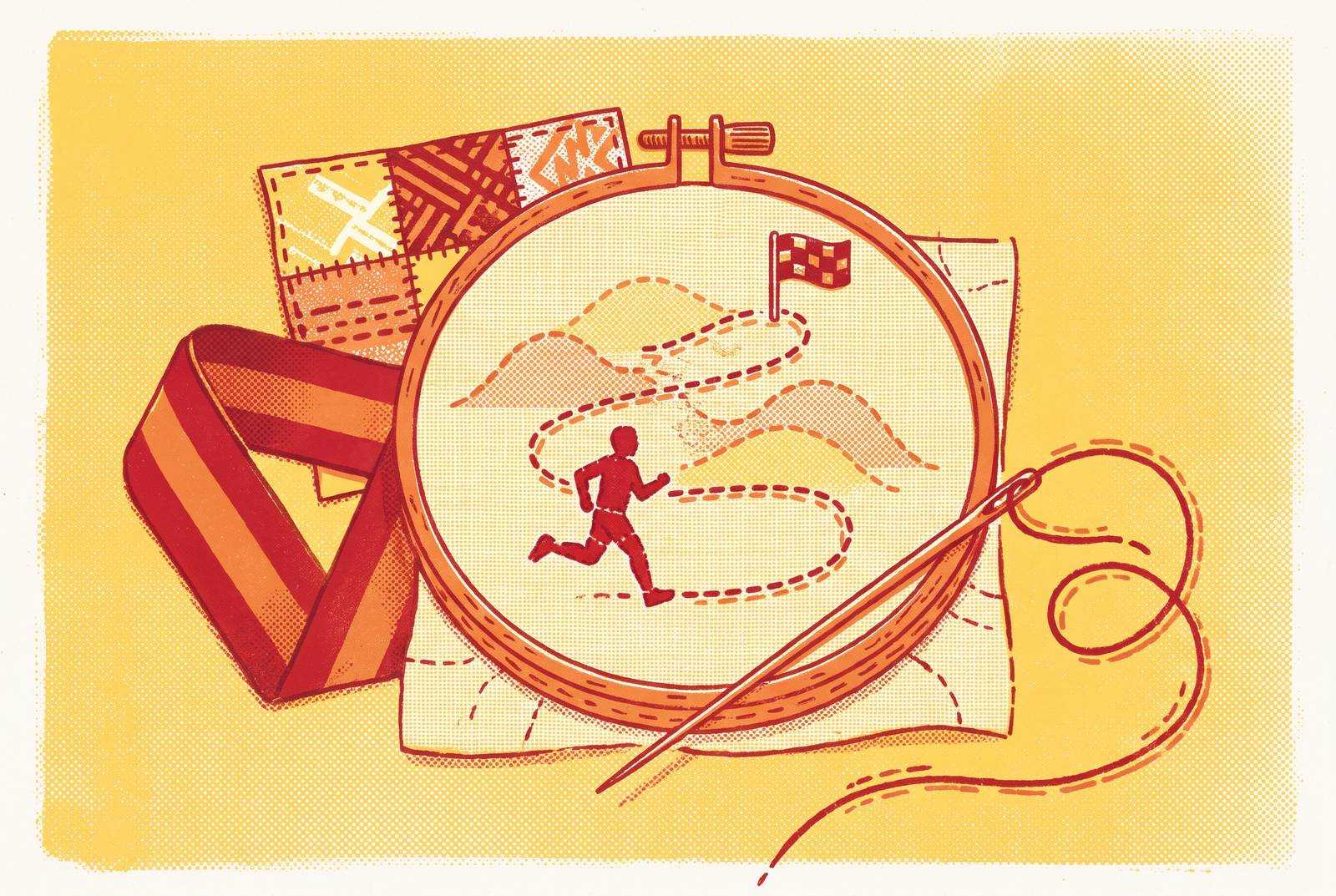
A made-to-order embroidered textile with the runner’s recorded course, finish time, race date, and bib number makes a good personalized gift for someone who has finished a marathon. For someone who has finished a first marathon, those details make the gift a keepsake that running gear made for anyone cannot be. Embroidery and textile art offer a particularly personal form of commemoration because they turn the documentary record of an achievement into something tactile that the runner can keep wearing.
Why a finish line moment needs more than a medal to hold its meaning
Holding a medal the morning after a marathon can leave a runner with the sense that something is missing. The medal marks the finish, but it cannot, by itself, explain what reaching that finish required. The achievement is a day earned through months of choices, with a meaning for the runner that the official race object may only partly capture.
That distinction explains why a finish time, course, date, and bib number deserve more than a decorative role. They are the documentary record of a personal event, whose motivation may involve self-esteem, psychological coping, life meaning, or goal achievement. A commemorative object becomes more revealing when it identifies the event precisely enough for the runner to recover the story behind it.
A “26.2” sticker or a finisher shirt without a name serves a different purpose. It marks membership in a category rather than identifying this runner’s participation in this race after this buildup. Neither function is without value, but they are not interchangeable. What can preserve the more individual story, and why does embroidery come close? Thread on fabric can combine those identifying details on a wearable object.
What the training buildup actually contains, and why any honest commemoration must account for it
The standard marathon training arc runs roughly 14–20 weeks, and its stages give the finish much of its emotional weight. Weekend long runs, typically on Saturday or Sunday, recur through that period as the training load builds. Progressive overload brings the runner to weeks of peak intensity before the taper changes the rhythm again. Each stage has its own remembered texture. A piece that records only race day leaves this longer chronology outside the frame.
The taper shows how running less can still leave a runner under emotional strain. As the body repairs itself and glycogen tops up, runners may feel restless or anxious. Running culture calls this “taper madness.” The weeks before the start line are already part of the achievement.
A finish time records the result, while the number of runs, total miles, and weeks logged give that result a history. They make the buildup visible. Including them asks the design to acknowledge the work that made race day possible.
Why the race bib carries more emotional weight than the medal, and what that tells designers
Many runners report a stronger attachment to their race bib than to their finisher medal because the bib traveled the distance with them. Its race name, number, and date show which race the runner took part in, and carrying it through every mile gives those details more weight. It was there throughout the effort. The medal marks the finish afterward, while the bib is a record the runner carried during the race itself.
That attachment offers a precise design lesson. A stitched piece that echoes a bib’s layout, including the race name, number, and date, draws on a format the runner already associates with the experience. A generic medal illustration cannot offer the same identification.
Numbers such as 26.2, 13.1, and 3.1 are factual, unbranded shorthand that runners recognize immediately. They establish a shared language. The more personal design anchors that language, or a recognizable city or course shape, to a name, bib number, or finish time. Community and individual meaning then reinforce each other on the fabric.
How GPS data turns a runner’s exact course into the raw material for embroidery
A runner’s GPS record gives a designer the route from that runner’s activity in place of a stock illustration of the event. A GPX export from Strava, Garmin, or another tracking app contains sampled geographic points approximating the path traveled. That distinction requires care. GPS drift and smoothing mean the record is not a perfectly exact trace, and Garmin devices natively record.FIT files, with GPX available through export. Its personal value lies in its connection to the runner’s recorded journey.
For embroidery, the course shape becomes the basis of stitch digitization, which converts the route into a thread path. The recorded journey becomes material for the design. The maker uses data from this runner’s effort in place of an image that could stand for any marathon. As a gift, that choice shows attention to the route, the place, and the event, rather than simply to the recipient’s interest in running.
Sporty-Art uses a runner’s route to make a custom running print. Its poster can include the race name, date, route, distance, runner’s name, time, bib number, ranking, and speed, with a preview before purchase. Memorace offers a related approach through local artists’ limited-edition finisher artwork personalized with the runner’s name and finishing time. These are adjacent options with different production methods. They show how race information can become art, while embroidery gives that information a different physical form through thread and fabric.
Why embroidery holds meaning differently than print, and what makes a stitched piece last
The 2026 Boston Marathon Celebration Jacket by Adidas provides a concrete example of runners attaching significance to embroidery itself. Its stitched logo answered criticism of the previous year’s printed, Bank of America-centric crest and drab colorway. The change was not merely technical. Runners noticed when print replaced stitching, so the way the jacket was made became part of what it meant to them. The B.A.A. describes the jacket as “a tradition stitched in history.”
That example shows that construction can belong to a commemorative tradition. Thread has a tactile presence that an ink impression does not, and runners already encounter it on highly valued race-related garments. For a personalized piece, the craft and the identifying details work together. The data says which achievement is being remembered, while the stitching gives that record a physical character.
Embroidery also has a structural durability advantage when it is properly planned and produced. Stitches interlock with the fabric rather than forming a surface layer that can crack or peel, and well-made embroidery withstands repeated washing better than heat-transfer or DTG printing. Digitization is the critical variable. Poorly planned stitching can create dense patches that pucker and pull, while expert digitizing distributes thread across the design so the garment remains wearable.
A design built from the runner’s data can be shown as a proof before production, allowing the runner or gift-giver to approve what will be stitched. Accuracy comes before the irreversible step. The proof establishes the content and arrangement, while the stitch planning determines how that approved design behaves on the fabric.
What the embroidered running keepsake market looks like, and what specificity costs compared to generic
The embroidered running keepsake market spans generic distance motifs, pieces personalized with a name and year, and more detailed commissions built around an individual record. A name and year make a design more personal by showing who it is for and when they ran. They do not, however, describe the GPS course, the training miles, or the weeks that led to the finish, so the extent of personalization remains limited.
The useful price comparison is therefore not simply between an inexpensive object and an expensive one. It is between what each object records. A generic motif marks the category of achievement, while a route-based commission can distinguish one finish from every other finish by the same runner. The gap in meaning can exceed the gap in price. Without directly comparable embroidered pieces and prices, however, that distinction cannot honestly be reduced to a numerical premium for specificity.
Memorace lists its personalized finisher artwork from 390,00 kr, a price for paper art. The medium changes the comparison. Growth in the wider personalized gifts market shows that people want keepsakes made for them, but a personalization label says little about how much of the runner’s story a piece tells. The stronger distinction is between adding an identifier to a standard design and building the design around the achievement.
How to choose a personalized marathon finisher gift before commissioning or buying one
For a buyer, the practical question is not whether a piece looks like running, but whether it holds the details that distinguish the recipient’s finish. The first step is to gather the runner’s exact finish time, race name and date, and bib number if available. A GPS-based commission also needs a Strava or Garmin link or a GPX export. Those details establish the design’s foundation. They also make it possible to distinguish an individually recorded route from a stock illustration shared by everyone who entered the race.
The next step is to assess the depth of the proposed personalization. A race name and distance identify the event, while the date, time, and bib number locate the runner within it. Adding training weeks and miles can bring the buildup into that record. The purpose of additional detail is to preserve the parts of the experience that make this achievement personal, selecting information for what it adds to the story.
Before production, the buyer should confirm that the piece is made to order and that a proof will be supplied for approval. This is the point to confirm the details and their arrangement before they become stitches. Craft deserves a separate question. The maker should be able to explain whether the stitch file was designed for the garment’s specific fabric weight and whether the piece has been tested through washing.
The choice between a wearable textile, a route-art print, and personalized finisher artwork ultimately includes how the runner will keep the record. A successful piece could only have been made for this runner, after this race, after these months of work. That is what turns a marathon gift into an honest commemoration.