Marathon Race Photography and What Runners Do With Their Finish Photos
Finish photos start as social posts and become keepsakes runners keep.
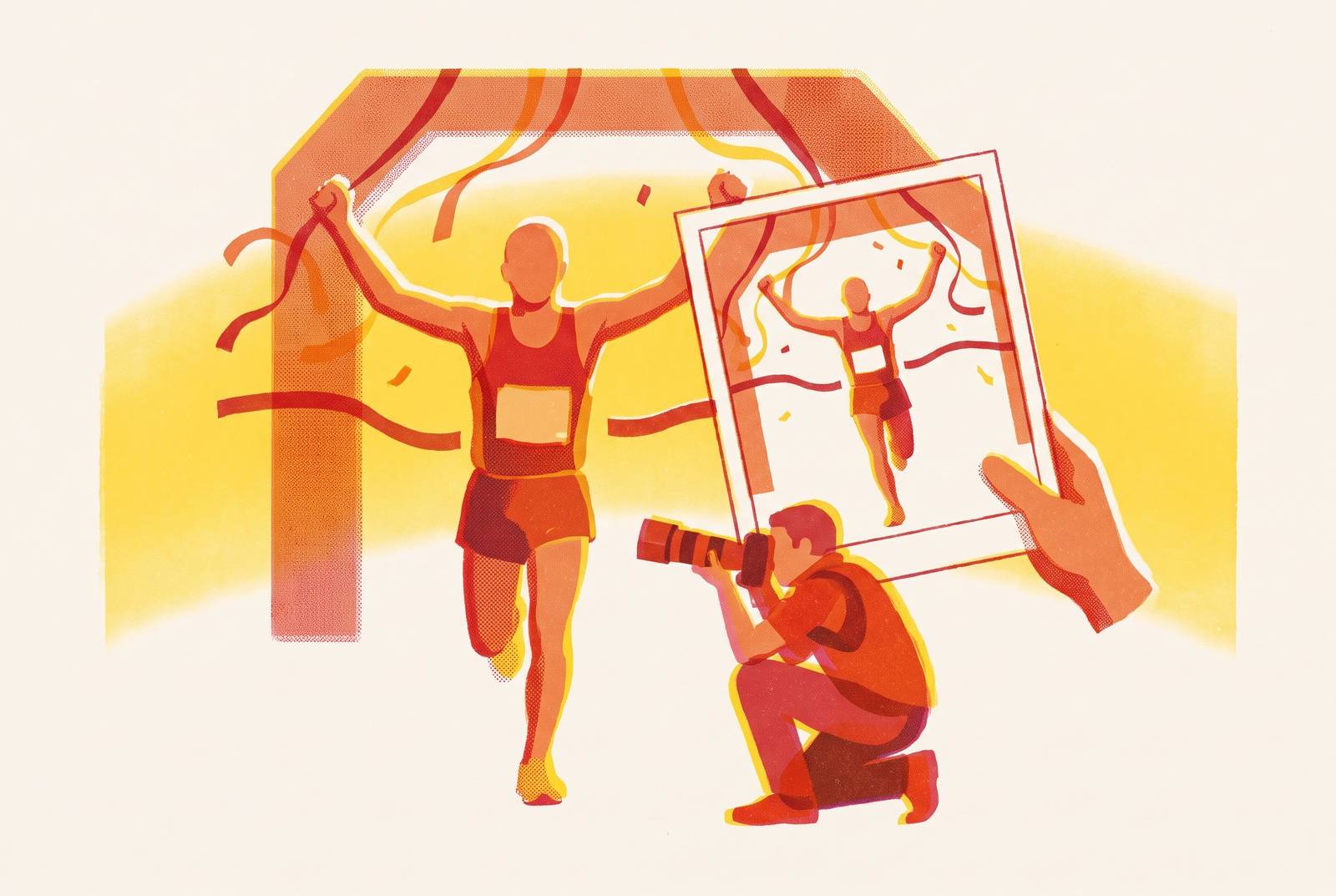
A personalized gift for a marathon finisher can preserve the finish photo, race route, bib, or medal, with the runner’s name, date, and finish time making it specific to their achievement. For someone completing a first marathon, a photo keepsake, route map, or shadow box recognizes more than the distance. Marathon race photography begins with documenting the finish, but what runners do with those images shows how they process, share, and preserve months of effort.
Why the finish-line photo carries more weight than it appears to
Training for a marathon takes months of early mornings, long runs, and self-doubt that almost nobody else sees. The public part lasts only a moment. A finish photograph gives others a glimpse of what the runner has been through largely on their own. It is not principally a portrait, and its significance does not depend on flattering light or composed posture. For most participants, finishing means more than the time recorded, because completing the distance establishes something about their own capability.
The 2026 Boston Marathon course from Hopkinton to Boylston Street produced images that make this distinction concrete. Vasileia Panteri of Greece raised her arms toward family after finishing her first Boston Marathon. Caleb Dayley kissed his fiancée after finishing his first Boston, while Sara Cornelius hugged her son Ace. The gestures need no technical explanation to be understood. Yet their full meaning belongs to the people in the photographs, who know what preceded the embrace or raised arms.
What runners actually do in the first hours after crossing the finish line
Runners start sharing before the official photographs are ready. They post medal photos, race statistics, and social profile updates to tell people right away that the work is done. The phone can come out before the foil blanket goes on. This is not a response that race organizers have to manufacture, because runners already have people they want to tell. Their first posts use whatever evidence is at hand rather than waiting for a professionally captured image.
Runify’s race photo data indicates that roughly half the field produces organic social content, including photos, splits, finish times, and course views, without an incentive from the race director. The same data shows that Facebook dominated runner photo sharing during the survey period despite Instagram’s visual-first format. That pattern suggests that runners share with family and people in their community as well as with followers. Documentation also starts well before the finish. Nearly one in three runners photographs the course during the race, creating a personal record in parallel with the official coverage. A finish photograph fits naturally into that record because it communicates the achievement more immediately than a chip time alone.
Why photo delivery timing determines whether a runner engages with their image at all
Runners check results, exchange experiences, interact with sponsors, and respond to people celebrating with them. When an official image arrives in those hours, it joins a conversation that is already going on. Days later, it has to restart one. The photograph may retain its personal significance, but the immediate opportunity to share it has narrowed as the runner’s attention moves elsewhere.
Kamero’s analysis of real-time delivery describes this loss of excitement and social activity as a decay curve. Runners interact much more with images sent through same-day AI delivery because they are still looking for them while finishing feels fresh. Before AI tagging, finding a photograph could mean looking through thousands of images sorted by when they were taken or where the photographer stood. That work was one reason so few runners engaged with or bought their photos.
How AI-powered race photography now delivers personalized images within minutes of the finish
Photographers can now send images straight from camera bodies to cloud infrastructure through wireless FTP connections instead of waiting to hand over memory cards after the race. Uploading begins while they are still shooting. Automated sorting, matching, indexing, and delivery can then start as images arrive, while the event is still underway. For the runner, the important change is not the connection itself but the disappearance of a long wait between capture and access. Runners can look for a race photograph while still in the finish area, days before they are home.
Matching systems use bib number detection, with facial recognition providing a secondary layer when a bib is not visible. This makes the gallery searchable by the person in the image rather than only by where or when the photographer stood. Advanced recognition and search systems can find a runner’s images in under three seconds after they enter a bib number or upload a face photograph. That search time is one part of the entire delivery interval. Photographs uploaded within minutes of being taken can then be found almost at once, though the steps happen one after another.
Why finish-line photos so often disappoint — and what runners can do about it before and after the race
Fast access does not make the finish area an easy place to photograph. Timing gantries, sponsor banners, barriers, cones, race officials, and other finishers compete for space in the frame. Harsh midday light and motion blur make the shot harder to get, and the photographer often needs a wide shot to include runners crossing together. Clutter is part of the working environment. A photograph can show an important moment as it happened and still be too cluttered for the runner to use.
Asking a friend to stand slightly low and to the side of the course just before the finish can capture the moment three seconds before crossing. The runner may have better form there, with less clutter and the same emotional charge. This gives the runner another view of the achievement alongside the official finish image, without depending entirely on the most congested point of the course.
Afterward, consumer-grade AI background isolation can make an edit in seconds that once took a professional designer an hour to do by hand. A distracting setting need not determine the image’s usefulness. For social posts, using the same fonts, colors, and layouts also helps a feed look polished, so less rests on skill with a camera. The practical aim is to make the runner and the moment legible. Once that is achieved, the edited image becomes material for something beyond a post.
How runners move from posting a photo to turning it into something that lasts
Social sharing answers an immediate need to tell people what happened. A keepsake answers a different need over time. The best time to share lasts hours, while finishing can mean just as much years later. For a growing number of runners, posting a photograph begins a more considered process of deciding how the race should be remembered. A physical object gives that memory a place outside the feed.
Etsy sellers offer a custom New York City Marathon route map poster personalized with the runner's name, time, distance, date, and coordinates. Another option is a shadow box frame that holds a Chicago Marathon race bib, finisher medal, photograph, and wooden race route map personalized with runner name and date. Sellers also offer a marathon runner custom race bib embroidered hoop ornament memento gift. The poster puts the course and result at its center, the shadow box holds several things from the race, and the embroidered ornament recreates the bib in another material.
The distinction is not simply decorative. A route map gives the distance a visible shape, while a photograph preserves an expression that the result cannot describe. A display can keep the map and photograph together. The choice depends on which part of the experience the runner wants close at hand, rather than on a single format being best for every finisher.
What the training data and GPS track add to the finish photo's meaning
The finish photograph shows the culmination, but not the work that made it possible. Training logs supply that missing duration. Weeks of runs accumulate in Strava and Garmin as a parallel archive that runners know closely and other people rarely see. A finish time shows how the runner did after that training, but leaves out how much training it took. Bringing the records together gives the final image a history.
GPS adds a different kind of specificity. The runner’s recorded line over 26.2 miles shows where they went through streets, across bridges, and through neighborhoods. The course may be shared, but the track documents that runner’s movement through it. GPS makes the line retrievable and displayable, allowing the route itself to become the central feature of a keepsake. It is evidence that also works as a drawing.
That connection extends to printed art and embroidery, where a route becomes a drawing, then a pattern, then something displayable or wearable. Raised topographical map plaques can include a colored route line, athlete name, date, distance, time, and elevation gain. Keepsakes that also incorporate training data can connect preparation with performance. A runner who trained using those logs has therefore generated much of the raw material before reaching the start, with the race adding the final record.
What should you get someone who just finished their first marathon?
A finish photo or race keepsake given by someone close to the runner has a meaning that a self-purchase does not. It acknowledges that the preparation was witnessed. Partners, parents, children, and friends often experience the early alarms, missed weekends, and tired evenings without participating in the training itself. A gift tied to the actual race makes that attention visible. The runner’s name, course, date, and time distinguish recognition of this achievement from congratulations that could apply to anyone.
For a gift-giver, the useful comparison is between what each format preserves. A photograph centers the runner’s expression, a personalized route map documents the course and result, and a shadow box brings the image together with the bib and medal. These are different ways to make the gift specific. Unlike a generic medal or T-shirt, their personal details can show precisely which race is being honored and who completed it. The relevant criterion is the connection to the runner.
A shadow box can be an appropriate present as a considered acknowledgment even when the runner would resist buying it as an impulse purchase at a finish-line kiosk. The most meaningful finish-line gifts document something the giver already understands, that the achievement was earned over months.
What all of this reveals about why runners run and how they want to remember it
Completing a marathon provides a tangible sequence of purpose, effort, and achievement. Runners often describe that sense of progress as extending into other parts of life, with the perseverance developed through training remaining useful after the race. A keepsake can therefore function as a reminder of capability as well as a source of nostalgia.
For someone who runs only a few marathons, each finish may mark a distinct period of life. The photograph preserves more than the fact of participation. Its expression can return the runner to the feeling of reaching a goal that demanded sustained work, while the personal details keep that feeling attached to a particular experience. A medal recognizes completion across the field, but a personal record preserves what completion meant to one person. The finish line is where the race ends. Commemoration is where the runner gives its meaning a lasting form.